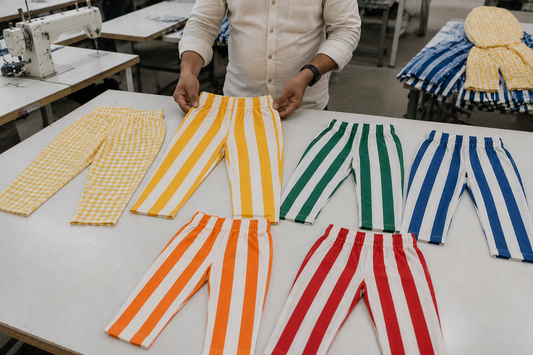

How to Wash Cotton Kids' Pants in India: Hard Water, Colours, and Machine Wash Tips
The Problem With Most Washing Advice for Kids' Cotton Pants in India
Most care label instructions are written for a global average that does not reflect Indian laundry conditions. They assume soft water, low-temperature machines with gentle cycles, and line drying in moderate climates. Indian households typically deal with hard water, variable machine quality, high summer temperatures, and strong direct sunlight. The standard care label instructions, designed for European or North American conditions, can give Indian parents guidance that actually damages their children's cotton clothing over time.
We manufacture cotton pants for Indian children and we hear directly from parents when clothes wear out too quickly, fade unevenly, or go stiff after repeated washing. In most cases, the cause is not a fabric defect. It is a washing method mismatch. This guide covers what actually works in Indian conditions.
Understanding Hard Water and What It Does to Cotton
Hard water is water with high dissolved mineral content, primarily calcium and magnesium. Most of North India, including Delhi, Haryana, Punjab, Rajasthan, and large parts of Gujarat and Maharashtra, has hard water. Chandigarh, Jaipur, and Ahmedabad are among the cities with notably hard municipal water.
Hard water affects cotton in two ways. First, detergent does not lather as effectively in hard water, which means you need more detergent to get the same cleaning action. More detergent residue means more chemicals left in the fabric after rinsing, which breaks down cotton fibres faster over time and can cause skin irritation in sensitive toddlers.
Second, the dissolved minerals in hard water deposit themselves in cotton fibres during washing. Over multiple wash cycles, this mineral buildup makes cotton feel stiff, scratchy, and heavy — the opposite of how it should feel. Parents often attribute this to the fabric ageing, when in reality it is mineral accumulation.
The solutions are straightforward. Use a liquid detergent rather than a powder in hard water areas — liquid detergents are formulated to work better in mineral-rich water. Add a small amount (half a cap) of white vinegar to the rinse cycle. Vinegar is mildly acidic and dissolves mineral deposits from cotton fibres. Do this every three to four washes rather than every single wash. And use a fabric conditioner in the final rinse to soften the cotton after the mineral exposure.
Temperature: Cold Water Washing Is Not Just for Delicates
Indian parents often assume that hot water cleans better. For most kids' cotton clothing, this is a misconception. Hot water — anything above 40 degrees Celsius — accelerates fibre breakdown in cotton, causes shrinkage in garments that have not been pre-shrunk, and speeds up colour fading in checked and striped patterns.
Cold water washing at 20–30 degrees Celsius, with a good liquid detergent and enough agitation time, removes the everyday dirt, food stains, and sweat from children's cotton pants just as effectively as hot water. For stubborn stains like turmeric or oil, pre-treat with a mild stain remover before the main wash rather than raising the wash temperature.
Our cotton pants are pre-shrunk during manufacturing, so the primary risk of hot water washing for our products is colour fading rather than size change. We recommend cold wash as the default for coloured cotton pants.
Machine Washing: The Right Cycle Matters
Indian washing machines vary widely in quality and cycle options. As a general rule, use the gentle or delicate cycle for cotton pants. These cycles have shorter agitation times and slower spin speeds, which reduces mechanical wear on the fabric. If your machine does not have a gentle cycle, use the shortest available wash cycle.
Wash coloured cotton pants inside out. This protects the outer surface — the side with the check or stripe pattern — from the direct mechanical abrasion of the wash drum. The inside surface, which sits against the drum, takes the wear instead. For our French Terry pants specifically, washing inside out also protects the outer stripe colour from fading.
Do not overload the machine. Overcrowded loads mean insufficient water circulation, poor rinsing, and excessive mechanical friction between garments. A half-full machine cleans better and is kinder to the fabric.
Drying in Indian Conditions
Line drying in shade is the best option for cotton kids' pants. Direct sunlight bleaches colour from cotton over time. A checked or gingham pant left regularly in intense direct sunlight will lose definition in the pattern within a few months. This is not a fabric defect; it is basic photodegradation of dye molecules.
In practical terms, this means drying on a shaded balcony, under an awning, or indoors near a window rather than on a terrace in full afternoon sun. Morning sun for a couple of hours is gentler than afternoon sun and is generally fine for most cotton colours.
Do not wring cotton pants tightly. Wringing twists and stresses the fibres and can distort the waistband elastic over time. Gently squeeze out excess water and hang to dry.
Find cotton pants that are built to last in our full collection.
Frequently Asked Questions
My cotton pants have gone stiff after a few washes. What is causing this?
Almost certainly hard water mineral buildup. Add half a cap of white vinegar to the rinse cycle for the next three washes and follow up with fabric conditioner. You should see the softness return within two to three washes.
Can I use Surf Excel or Ariel for washing cotton kids' pants?
Yes, both work well. We recommend using the liquid version rather than the powder in hard water areas, as liquids dissolve more completely and leave less residue. Use the recommended quantity — more detergent does not mean better cleaning and increases residue buildup.
Why do the check colours bleed slightly in the first wash?
A small amount of colour release in the first wash is normal for woven cotton with yarn-dyed threads. Wash separately or with similar colours for the first one or two washes. Bleeding typically stops after the initial wash or two.
Should I iron cotton kids' pants?
If you hang them promptly while slightly damp and smooth them out by hand, they dry with minimal creasing and generally do not need ironing. If ironing is necessary, use a medium heat setting and iron on the reverse side to protect the pattern.
Tags:
Previous
Gingham Pants for Kids: Why This Pattern Is Perfect for Indian Summers
Next
Why 30s Combed Cotton Is the Best Fabric for Kids' Pants in India