
Striped Pants for Kids: A Guide to Stripes, Checks and Gingham, from Playdate to Family Gathering
Striped pants for kids are one of the easiest bottoms you can buy. A good stripe or check goes with most plain tops, is smart enough for a family function and doesn't date the way cartoon prints do. For Indian weather, pick the pattern for the season: woven cotton gingham and checks for hot days, heavier French terry stripes for AC rooms and winter. Then style it with one rule: one pattern per outfit, and a plain top that picks up one colour from the pant. You can see every pattern we make in our cotton pants for kids collection.
We cut and stitch these pants in our own unit in Tiruppur, Tamil Nadu, so this guide is written from the factory floor. It covers stripes, gingham, checks, plaid and bright rainbow stripes: what makes each one different, which suits which child and season, and how to get the most outfits out of a few pairs.
In this guide
- The one rule behind every good stripe
- What kinds of striped pants are there for kids?
- Why stripes and checks outlast novelty prints
- Gingham, check or plaid: what is the difference?
- Which pattern should you choose? A side-by-side comparison
- How to style striped cotton pants for Indian kids
- Which stripe suits a toddler's proportions?
- How do you mix and match patterned pants?
- Which pattern and fabric for which season?
- How do you keep stripes and checks looking crisp?
- Our striped and check pants, explained
- Frequently asked questions
Shop this guide
 French Terry Dark Green Striped Pants for Kids₹799
 French Terry Black & White Striped Pants for Kids₹799
 The Mint Gingham Cotton Pants for Kids₹799
100% cotton · 7-day returns · Free shipping · COD on orders under ₹5,000
When We Started Making Striped Cotton Pants, We Had One Rule
The stripe had to work everywhere. Not just at home, not just for play, not just in photographs. It had to be the kind of pattern a parent could put on a toddler at 7 in the morning and still feel good about at a 4 PM family gathering, a park playdate or a school pickup.
That is a high bar for a pattern. Stripes, handled well, clear it easily. Handled badly, they look cheap and then dated. The same is true of checks and gingham, which is why we make all three, and why this guide covers them together.
What Kinds of Striped Pants Are There for Kids?
If you've ever searched "what are pants with lines on them called", the short answer is striped pants. But stripes are not all the same. They differ in width, colour contrast and direction, and each one gives a different look and suits different occasions.
Narrow stripes
Classic, neat and a little formal. Pinstripes and fine-line stripes look smart even on small children. They go well with plain shirts and suit slightly dressier occasions without looking stiff.
Wide stripes
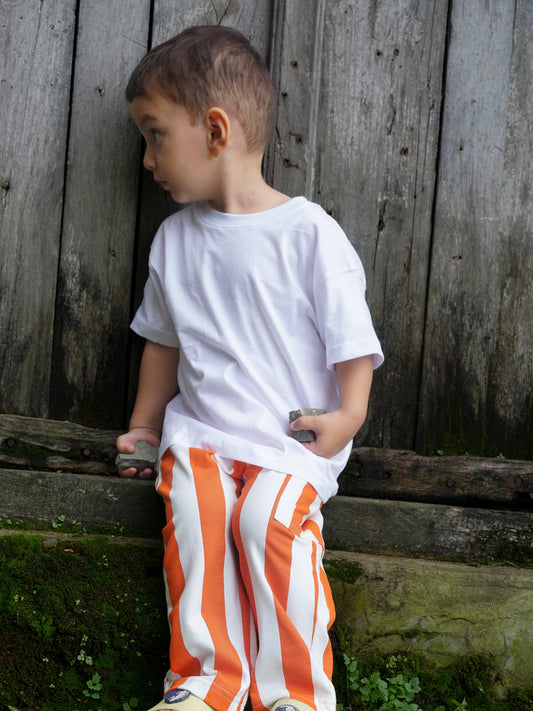
Bold, energetic and playful. Wide stripes catch the eye more and suit active, casual wear. They look best with a simple, solid top in one of the stripe colours.
Sailor (Breton) stripes
Alternating bands of navy or dark blue with white. Sailor stripes have been part of children's clothing for generations for good reason: the combination is clean, gender-neutral and suits almost every child. Navy and white is one of the steadiest colour pairs in clothing. It works across seasons, ages and occasions, and very few tops clash with it.
French stripes
"French stripes" is the name many people use for the Breton family: evenly spaced stripes, usually one strong colour on a pale base. Our French terry stripe pants sit close to this look. They have a bold stripe on the outer face and an undyed cotton base, in blue, red, yellow, dark green and black and white.
Multicolour and rainbow stripes
Energetic, fun, and the stripe children pick for themselves. Rainbow stripes are the pants toddlers point at and refuse to take off. A multicolour stripe on well-made pure cotton in a considered cut is not gaudy. It is joyful.
It also fits how India dresses. Indian textiles, festivals and homes have always embraced saturated colour, and children's clothing has traditionally reflected that. The newer pull towards muted, "minimal" kidswear comes largely from Instagram and Scandinavian design. Both have their place, and a wardrobe can hold both. One honest note from the factory: multicolour stripes are harder to make well. Each colour has to sit at the right width with clean edges, because colour bleeding into the next stripe makes the whole pattern look muddy. Look closely at the stripe edges before you buy.
Why Stripes and Checks Outlast Novelty Prints
Every kids' brand makes novelty prints: dinosaurs, cartoon characters, vehicles, animals. Children love them and, for a few weeks, everyone is happy. Then two things happen.
First, the child gets bored or obsessed. Either they refuse the dinosaur pant because they want the other dinosaur pant, or they insist on wearing only the dinosaur pant every day until it falls apart.
Second, novelty prints are harder to style. A pant with a large cartoon print really only works with a plain white or navy top. A stripe or check pant goes with most solid colours, and with some subtle patterns too.
In cost-per-wear terms, a classic stripe or check almost always wins. It doesn't date as quickly, pairs more easily and can be handed down to a younger sibling without looking babyish.
Gingham, Check or Plaid: What Is the Difference?
People use these words as if they meant the same thing. They don't, and the difference affects how easy the pants are to style.
Gingham
Gingham is a light, plain-woven cotton fabric with checks or stripes made from coloured yarns. Today it usually means a small, even, two-colour check: solid squares, white squares and blended squares where the colours cross. Encyclopaedia Britannica traces the name to the Malay word genggang, meaning "striped", which reached Europe through the French guingan. So gingham started in Asia, travelled to Europe through trade and never went out of fashion.
The simple, even pattern is why gingham works so well on small children. It looks neat without overwhelming a small frame. A toddler in gingham pants looks put-together without looking overdressed.
Check
"Check" is the umbrella word for any pattern of squares. Gingham is one kind of check. A "baby blue check" or "big check" may be a larger grid or a different colour balance, but it still reads as a tidy, two-tone pattern. If you're searching for check pants for boys or girls, this is the family you mean.
Plaid (and tartan)
Plaid has crossing lines in more than one colour and more than one width, so you get a grid of squares and rectangles. It looks busier than gingham. In a small scale it can look slightly formal, and in a large scale more rustic and casual. Because plaid carries more colours, you need to think a little more about the top: pick one of its colours, or a neutral.
Woven, not printed: why it matters
Here is a manufacturing detail most shoppers never hear. Many "check" pants in the local market are plain fabric with a grid printed on top. That is cheaper to make, but it looks flat and the print can crack or fade.
The checks and gingham in our cotton pants are woven into the cloth rather than printed on top, so the pattern stays crisp wash after wash. Because the colour is in the yarn itself, a woven check has a depth and texture a print can't copy. Our woven check and gingham pants are certified to OEKO-TEX Standard 100, which tests textiles against a list of more than 1,000 harmful substances, and they use azo-free dyes.
Our French terry stripes are made differently, and it's worth knowing why. The stripe is printed on the outer face only. The looped inner face that touches your child's skin is undyed cotton: it has been prepared, but never dyed. You get a bold stripe outside and plain cotton inside.
Which Pattern Should You Choose? A Side-by-Side Comparison
This is how we would explain it to a parent standing in front of all four options and trying to decide.
| Pattern | Look | Easiest tops | Best occasions | Best season in our range |
|---|---|---|---|---|
| Sailor or classic blue stripe | Clean, timeless, calm | White, navy, yellow, coral, red | Daily wear, playschool, family outings | All year |
| Black and white stripe | Sharp, dressed-up | White shirt, grey, red | Functions, photos, school events | AC rooms, evenings, winter (French terry) |
| Bright single-colour stripe (red, yellow) | Cheerful, festive | White, cream, navy, grey | Birthdays, Diwali, weekends | AC rooms, evenings, winter (French terry) |
| Rainbow or multicolour stripe | Playful, joyful | White, almost always | Parties, playdates, holidays | Depends on the fabric |
| Gingham (small even check) | Neat, fresh, classic | Any solid: white, navy, yellow, lavender | Summer outings, playschool, lunches | Hot and humid months (woven cotton) |
| Larger check or plaid | Rustic, smart-casual | One colour from the check, or white | Family gatherings, outings | Hot months and indoor wear (woven cotton) |
Sailor stripes vs plaid: the practical comparison
- Versatility: sailor stripes win by a small margin. Two colours means fewer styling rules. Plaid needs a little more thought about the top.
- Occasions: about the same. Both are casual to smart-casual, and both work for anything from daily wear to family gatherings.
- Boys and girls: both are gender-neutral. The colourway matters more than the pattern. A forest green or navy plaid can read as more traditionally boyish, a pink or lavender one as more girlish, but plenty of families ignore that.
- Age: both work from toddlerhood up. Simpler patterns can suit the youngest toddlers slightly better, and a larger plaid can look striking on older children.
- Weather: it depends on the fabric, not the pattern. A woven cotton plaid is a summer pant, and a French terry stripe is a cooler-weather pant.
Our advice for a first pair: start with a classic blue stripe or a two-tone check. Either goes with almost anything already in the cupboard. Add a plaid, a gingham in another colour or a bright stripe as the second pair, for variety.
Cool check or warm check? Baby Blue Check vs Melon Gingham
These two of our woven pants make a good example of how colour, not pattern, changes a pant. Both are pure cotton with the same relaxed fit, soft elastic waistband with drawstring and size range.
- Baby Blue Check is crisp, calm and a little understated. Blue and white go with white, navy, yellow, coral, orange, lavender, grey and most neutrals. It doesn't belong to any one season, so it's the safer pick for a wardrobe staple, a hand-me-down or a gift when you don't know the child's taste.
- Melon Gingham is a warm coral-red and white check. It draws more attention and looks lovely outdoors in natural light, which is why parents who photograph their children often choose it. It reads more as a summer and festive pant. White, cream, navy and soft yellow tops suit it best.
A small, honest difference: in our experience, red and coral shades soften with repeated washing a little sooner than blues do. Cold washes, turning the pants inside out and drying in shade help both, and the red even more.
How to Style Striped Cotton Pants for Indian Kids
The basic rule is to match one of the stripe colours in the top. With navy and white stripes, a navy or white t-shirt works straight away. A coral or yellow t-shirt also works, because it contrasts with the blue-white base.
Tops to wear with striped pants, by stripe:
- Blue stripes: white, grey, yellow, red and even printed tees.
- Black and white stripes: a plain white shirt makes them look dressed up for a family lunch or a school event. Monochrome also photographs well, because nothing clashes with the background.
- Red stripes: white or cream for a festive look at Diwali, birthdays or a cousin's wedding, and a plain tee on an ordinary day.
- Yellow stripes: a plain white tee is all it needs. Navy and grey also work.
- Dark green stripes: white, off-white, olive, mustard or terracotta. Dark green behaves like a neutral without being beige, and it hides grass and park dust far better than pale colours.
- Rainbow stripes: white. It gives every colour in the stripe a clean background. If you want to match one colour, such as coral, it has to be exactly the right shade, so white is easier and looks just as good.
Stripes and checks with Indian wear
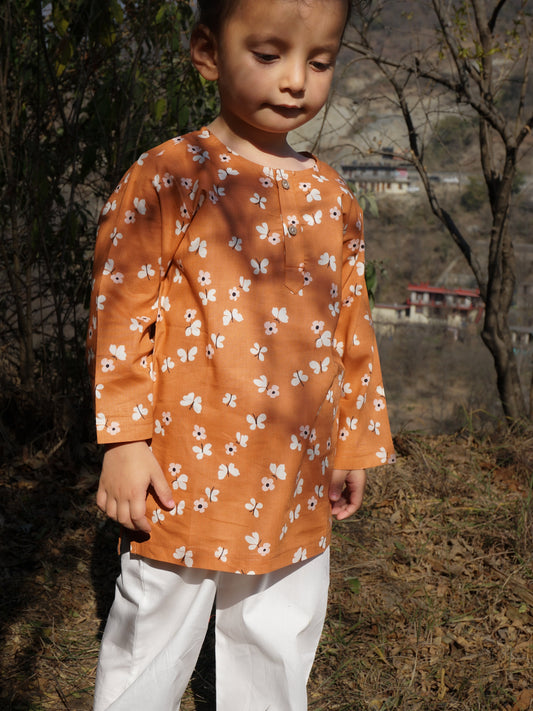
Striped and check cotton pants look surprisingly good with Indian tops. A stripe pant under a short cotton kurta looks smart, comfortable and modern-Indian, and we see more and more parents dressing boys this way for festivals and family functions. A gingham pant with a kurta or a printed cotton shirt has the same effect: the Western pattern against a traditional top makes an interesting contrast that suits children well.
How to style check and gingham pants
Keep everything else solid. A check is already a pattern, so a second pattern makes the outfit look cluttered. A gingham pant with a solid tee is a complete, balanced outfit: the pant gives the pattern, the top gives the colour. For everyday playschool or playdate wear, a white or off-white cotton t-shirt with gingham pants is one of the most reliable combinations you can build a toddler's wardrobe around.
Which Stripe Suits a Toddler's Proportions?
Parents sometimes ask how to choose striped trousers for their child's body type. Toddlers have short legs compared with the rest of their body, so very wide horizontal bands can make short legs look shorter still.
A few practical pointers:
- Medium-width stripes give a pant rhythm without overwhelming a small frame. Our French terry stripes are designed this way, a choice we made based on feedback from Indian parents.
- Small checks and gingham scale nicely on little bodies. Save very large plaids for older children, where the scale looks proportionate.
- A top in one of the pant's colours makes the outfit read as one long line, which flatters any height.
- Fit matters more than pattern. Our pants have a relaxed fit with room to squat, crawl, run and sit cross-legged, so the pattern hangs evenly instead of pulling across the knees.
How Do You Mix and Match Patterned Pants to Get More Outfits?
A question we hear often: "I have three pairs of your pants, a check, a stripe and a gingham. How do I get the most outfits without buying lots of tops?" Mixing and matching is simpler than most parents think, and more systematic than grabbing whatever is clean.
The one-pattern rule
If the pants have a pattern, the top should be a solid colour. It isn't a strict law, but it's the most reliable starting point. When two patterns meet, the eye tries to reconcile them, and making that work takes scale and colour planning nobody wants to do at 7 in the morning. Solid tops with patterned pants work every time, without any thought. That's what makes a small wardrobe feel like a big one.
The colour anchor
Pull one colour from the pant and repeat it in the top, or use the pant's neutral partner (usually white). Blue check takes a blue or a white top. A red gingham takes a coral, soft red or white top. Blue and white stripes take navy or white.
A pairing matrix you can copy
Say you own three pairs: a blue check, a blue stripe and a dark green stripe. These five solid tops give you the most combinations:
| Solid top | Blue check pants | Blue stripe pants | Dark green stripe pants |
|---|---|---|---|
| White | Yes | Yes | Yes |
| Navy | Yes | Yes | Skip (two dark shades) |
| Yellow or mustard | Yes | Yes | Yes |
| Coral or terracotta | Yes | Yes | Yes |
| Grey or olive | Grey | Grey | Olive |
Five solid tops and three pairs of pants give you fourteen outfits that work without any thought. Add a sixth top and you get more. That's how a small, minimal wardrobe still feels varied. If you like this approach, our guide to building a capsule wardrobe for kids takes it further, across the whole cupboard.
Can you ever mix patterns?
Yes, with the scale rule: one pattern should be clearly smaller than the other. A fine-stripe top with a large-check pant works because the scales differ. A large stripe with a large stripe is too much of the same. Small prints such as tiny dots, micro-prints or subtle texture work with stripes if they share at least one colour.
What to avoid with check pants: large florals, bold geometric prints and heavy graphics. Also be careful with a top that clashes with both colours of the check, for example a bright green top with red-and-white gingham. That gives you three competing colours and nothing to tie them together.
Seasonal tweaks
In peak summer, bright, high-contrast pairings look fresh: a white top with bold gingham, a yellow top with blue stripes. In cooler months, muted pairings feel more seasonal: olive with dark green stripes, mustard with caramel stripes. You don't need different pants for this. The pattern stays neutral, and the top gives the outfit its seasonal mood.
How many pairs do you need?
Three pairs in different patterns give plenty of variety. Beyond four or five, you need more tops to make use of them, and the point of a minimal wardrobe starts to fade.
Which Pattern and Fabric for Which Season?
Pattern is about looks. Fabric decides whether your child is comfortable. In our range, the two go together like this:
- Woven cotton gingham and checks are light, breathable everyday pants for hot, humid weather. Pure cotton breathes in 35°C+ heat and absorbs sweat without clinging. This is the pick for summer outings, playschool and long Indian afternoons.
- French terry stripes (240 GSM) are a heavier knit, looped inside and smooth outside. Reach for these in air-conditioned rooms, on cooler evenings and in North Indian winters. If GSM is new to you, our explainer on what GSM in fabric means covers it in two minutes, and our manufacturer's guide to French terry explains the knit.
Whatever the pattern, we use no polyester in these pants. If you're weighing fabrics, our comparison of cotton vs polyester pants for kids in Indian summer explains why.
How Do You Keep Stripes and Checks Looking Crisp?
Patterned pants show their age through colour, so a little care goes a long way.
- Wash cold with similar colours. Our care labels say this for every pair. Keep reds and darks away from whites.
- Turn the pants inside out. Cotton Incorporated's washing guide recommends turning clothes inside out and sorting lights from darks, because fabric rubbing against fabric in the drum creates fuzz that makes colours look faded.
- Dry in shade. Strong sun is hard on reds and bright shades in particular.
- No bleach, even on black and white stripes. Cold washing and shade drying keep the whites white and the blacks crisp.
- Follow the fabric: woven check and gingham pants can be tumble dried on low or line dried and need no ironing. French terry pants should not be tumble dried, and if you iron them, do it inside out on low heat.
Do stripes fade faster than solid colours? Not usually. A two-colour stripe holds colour much like a solid pant. Multicolour designs can look uneven over time if one colour fades faster than the others, which is why cold, inside-out washing matters most for rainbow stripes. Woven checks keep their definition especially well, because the colour is in the yarn. For hard water, stains and machine settings, our complete guide to cotton pants for kids in India has a full care section.
Our Striped and Check Pants, Explained
Why we make check pants at all: working in Tiruppur, we see thousands of metres of fabric every day, and the classic check pant has always held a special place for us. Parents often tell us, "I saw pants like these on a mood board, but I could never find them here!" In India you usually found either stiff prints that faded quickly, or imported pants with price tags that made your eyes water. We wanted that relaxed, timeless check look in Indian wardrobes, made properly and at an honest price.
Parents regularly write to tell us their check pants get compliments, and that grandparents love the traditional look while other parents love the modern one. A pant the whole family agrees on is a rare win.

Woven checks and gingham (pure cotton, lightweight)
Our woven pants are 100% long-staple, export-grade cotton sourced in Tamil Nadu, with a relaxed low-crotch fit and a soft elastic waistband with drawstring.
- Baby Blue Check Pants: the calm, go-with-everything check, in sizes from 6 to 12 months up to 7 to 8 years.
- Mint Gingham Pants: a soft green and white gingham that is light and breathable for summer.
- Rustwood Checks Cotton Pants: a warmer, plaid-style check for parents who want something a little more rustic.
French terry stripes (240 GSM, undyed inner face)
These come in sizes 1 to 2 years through 7 to 8 years and are sized a little bigger than most brands, so order your child's age.
- Blue Striped Pant: the workhorse stripe that never looks wrong with anything in the cupboard.
- Black and White Stripes: the sharpest pair, and the one that reads as dressed rather than play clothes.
- Red Striped Pants: the celebration pair for Diwali, birthdays and functions.
- Dark Green Striped Pants: the stripe that behaves like a neutral and forgives park dust.
- Caramel Stripe Pant: rust-orange and off-white retro stripes with a roomy cargo pocket.
All our pants are unisex: the same cut for boys and girls, so you choose by colour, pattern and fabric weight. Cotton pants in the range are priced from ₹699 to ₹799, and sizes vary by style, so check the size options on each product. Browse every stripe, check and gingham in our cotton pants for kids collection.
Frequently Asked Questions
What are pants with lines on them called?
Pants with lines running along or across them are called striped pants. Navy and white bands are sailor or Breton stripes. Very fine lines are pinstripes. Lines crossing in both directions make a check, gingham or plaid.
What tops go with striped pants for kids?
A plain top in one of the stripe colours is the safest choice, and white works with almost every stripe. Navy, yellow, grey and coral go well with blue stripes, and white or cream with red. With rainbow stripes, stick to white.
Are check pants good for boys? And for girls?
Yes, for both. Checks and gingham are genuinely gender-neutral patterns, and all our pants use the same unisex cut. Colour makes more difference than the pattern: blue checks read neutral to most people, while red or pink can feel more traditionally girlish, though many families buy both regardless.
What is the difference between gingham, check and plaid?
Gingham is a small, even, two-colour check on light plain-woven cotton. "Check" is the umbrella word for any pattern of squares. Plaid uses several colours and line widths crossing each other, so it looks busier and needs a little more care when choosing a top.
Are gingham pants good for Indian summers?
Yes. Woven cotton gingham is lightweight and breathable, absorbs sweat without clinging and stays crisp because the check is woven into the cloth rather than printed on top. For AC rooms and winter evenings, a heavier French terry stripe is the better choice.
Do striped or checked cotton pants fade?
All coloured cotton softens a little over time. Two-colour stripes hold colour much like solid pants, woven checks keep their definition well, and reds tend to soften before blues. Wash cold and inside out with similar colours, skip bleach and dry in shade.
Can striped pants be worn to school, birthday parties and family functions?
Yes. Most Indian playschools and preschools are happy with smart-casual stripes and checks for young children (check your school's policy for older classes). For parties and functions, pair a classic stripe or check with a collared shirt, a smart solid top or a short cotton kurta.
Which stripe or check is the most versatile first buy?
A classic blue stripe or a blue and white check. Both go with almost every top colour, work all year and suit boys and girls equally. Add a bright stripe, a gingham in another colour or a plaid as your second pair.
Tags:
Previous
Cotton vs Polyester Pants for Kids in Indian Summer: A Manufacturer Explains
Next
Cotton Pants for Kids in India: A Manufacturer's Guide to Fabric, Fit and Sizing (6M to 8Y)