
Traditional Dress for Baby Boy (1 to 3 Years): A Maker's Guide to Kurta Fit, Size by Height and Safe Fabric
The best traditional dress for a baby boy is a soft cotton kurta with a relaxed, pull-on pajama. It looks properly festive in photos, comes off in seconds for a nappy change, and lets him crawl, sit on the floor at a puja or nap on someone's shoulder without fuss. Choose fine, breathable cotton with no beads or sequins, 3/4 sleeves, an easy neck opening and a size based on his height rather than his age. If you are shopping for his first Diwali, a naming ceremony or a family wedding, start with our cotton kurta pajama for baby boy and girl range, sized from 1-2 Y.
We make kidswear in our own unit in Tiruppur, so this guide is written from the cutting table, not the catalogue. Below you will find what works at 1, 2 and 3 years, an occasion chart for the ceremonies of a baby's first years, our real garment measurements matched to WHO height data, and a checklist you can use on any kurta, ours or anyone else's.
In this guide
- What is the best traditional dress for a baby boy?
- Which traditional outfit suits a 1, 2 or 3 year old?
- What should a baby boy wear for each ceremony and festival?
- Which fabric is safest for a baby's kurta?
- How should a baby boy's kurta pajama fit?
- What size kurta does a baby boy need? (size chart by height)
- Kurta pajama, kurta only or dhoti kurta?
- How do you dress a baby boy in a kurta in winter?
- How many traditional outfits does a baby boy need?
- The 12-point checklist before you buy
- Frequently asked questions
What is the best traditional dress for a baby boy?
For babies and toddlers, Indian traditional dress comes down to a handful of shapes: the kurta pajama, the kurta with a pre-stitched dhoti, the veshti or pancha with a shirt in South India, the mundu in Kerala, and the sherwani or jacket sets you see at weddings. All of them can look lovely. Only some of them work on a child who still wears nappies, cannot sit still for more than four minutes and will put anything shiny in his mouth.
The kurta pajama wins for most families because it solves three baby problems at once:
- Nappy changes. A relaxed pull-on pajama comes down and goes back up in seconds. A draped dhoti or a fitted churidar does not.
- Floor time. Pujas, havans and naming ceremonies happen on the floor. A straight, roomy pajama lets him crawl and sit cross-legged without pulling at the knees.
- Repeat wear. A plain or printed cotton kurta works for Diwali, Eid, Rakhi, birthdays and family lunches, so you are not buying a new outfit for every event.
Keep the dhoti, veshti or sherwani for the 20 minutes of the main ritual or photo if the family wants it, and let the cotton kurta pajama do the rest of the day.

Which traditional outfit suits a 1, 2 or 3 year old?
A baby's traditional outfit should follow what his body is doing that year, not what looks best on the hanger. This is how we think about it when we design and grade sizes.
| Age | What he is doing | What works | Skip |
|---|---|---|---|
| 12 to 18 months | Crawling, cruising, first steps, frequent nappy changes, naps on laps | Short, soft kurta that ends around mid-thigh; pull-on pajama with room for a nappy | Long kurtas he kneels on, churidars, dhotis that need retying, anything with beads |
| 18 to 24 months | Walking fast, climbing steps, eating with his hands | Kurta pajama with 3/4 sleeves that stay out of food; print that hides small spills | Full sleeves with cuffs, stiff collars, heavy embroidery |
| 2 to 3 years | Potty training, running with cousins, wanting to dress "like Papa" | Relaxed pajama he can pull down himself; a matching set with Papa if the family likes it | Drawstrings he cannot untie in a hurry, button-fly pants, tight dhoti knots |
| 3 years and up | Sitting through longer rituals, posing for photos | Kurta pajama, a pre-stitched dhoti kurta for one ritual, a kurta with a light jacket in winter | Long trailing stoles and dupattas he can trip over |
For older boys, from 3 up to 8, our traditional dress for boys guide covers churidars, Nehru jackets and sherwanis in more depth.
What should a baby boy wear for each ceremony and festival?
The first three years bring more traditional functions than any other stretch of childhood. Diwali falls on Sunday, 8 November this year, and wedding season runs straight after it, so many babies have three or four functions in eight weeks. Use this chart to plan.
| Occasion | What the baby does | What works | Maker's tip |
|---|---|---|---|
| First Diwali | Evening puja, lamps, lots of people holding him | Golden yellow or white cotton kurta pajama | Choose 3/4 sleeves and no loose layers near diyas. Keep babies well away from firecrackers and sparklers, whatever they wear. |
| Annaprashan (first rice) | Sits on a lap and is fed; food goes everywhere | Short cotton kurta that washes easily; dhoti only for the photo if family tradition asks | Pick a print or colour that forgives kheer and dal |
| Naming ceremony | Long ritual on the floor, passed between relatives | Soft white or pastel kurta pajama | Nothing scratchy at the neck: he will be held close by many people |
| Mundan (first haircut) | Hair falls on clothes; often a temple visit | An older or kurta-only piece, then a fresh kurta after the bath | Keep the good kurta for after the bath and the family photos |
| First birthday | Morning puja, evening cake | Kurta pajama for the puja; a change for the party | See our 1st birthday dress for baby boy guide for the full day plan |
| Family wedding | Six or more hours, several functions, late nights | Two kurta pajamas plus a warm layer for night functions | Our wedding dress for baby boy guide has a function-by-function packing chart |
| Pongal, Sankranti, Onam, Vishu | Temple, family lunch on the floor | White or cream kurta pajama, or a small veshti or mundu with a shirt for the photo | Elastic-waist veshti versions are far easier on a toddler than a tied one |
| Eid and Rakhi | Visiting relatives all day | White or soft-coloured cotton kurta pajama | Fine cotton stays comfortable through a full day of travel and hugs |

For his first Diwali
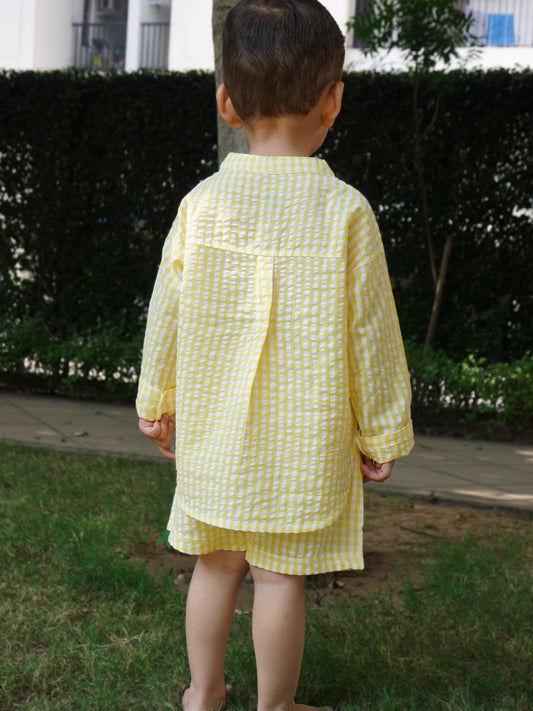
The Golden Daisy Kurta Pajama
Golden yellow print in fine 60s Indian cotton, OEKO-TEX certified fabric, 3/4 sleeves. Sizes 1-2 Y to 7-8 Y.
₹1,099See sizes →
Which fabric is safest for a baby's kurta?
A baby's skin is in contact with his clothes almost all day, and a toddler chews on his own sleeve more often than you would think. So the fabric question has three parts: the fibre, how fine the yarn is, and what has been put on it.
1. Pure cotton, not polyester blends or "art silk"
Festive baby wear is often made in polyester satin, art silk or tissue because they shine in photos. They also trap heat and sweat, which is why so many babies start crying an hour into a function. Cotton lets air and moisture through. That is the main reason we do not make polyester festive wear for kids.
2. Fine yarn: what "60s cotton" means
Most of our festive kurta pajamas are made from 60s Indian cotton. The "60s" is the yarn count: the higher the number, the finer the thread. Much everyday cotton is 40s, which is decent but a little thicker. Finer 60s yarn weaves into fabric that is smoother, lighter and more breathable, which matters when a baby is sitting through a long puja or a warm wedding lunch. Our white set uses poplin, a plain weave with a tight, even structure that gives a smooth, crisp surface and stands up to repeated washing.
3. Certification and dyes
Look for OEKO-TEX certified fabric. Under OEKO-TEX STANDARD 100, products for babies and children up to 3 years fall into Product Class 1, which has the strictest requirements and limit values of all the classes. When a seller says a baby garment is "OEKO-TEX", it is fair to ask which product class the certificate covers. The fabric in our 60s cotton kurta pajamas is OEKO-TEX certified and coloured with reactive dyes, which bond with the cotton fibre rather than sitting on top of it.
4. No beads, sequins or loose trims
The American Academy of Pediatrics notes that babies and toddlers are at the highest risk of choking and advises avoiding toys with small or detachable parts. Apply the same rule to clothes: a bead, mirror or sequin that he can pull off belongs on an adult's outfit, not his. Zari and metallic embroidery also scratch the inner arm and neck over a long day.

How should a baby boy's kurta pajama fit?
Fit is where most baby ethnic wear goes wrong. Here is what we look for when we sample a new kurta pattern, and what you can check in a shop or the moment a parcel arrives.
- Neck: The opening must pass over his head without dragging across his ears or nose. A short placket at the front makes this easy. If the neck is tight on the first wear, it will be a battle at every function.
- Sleeves: 3/4 sleeves are not just a style choice. Our kurtas use them on purpose: sleeves do not dip into food at a function, arms move freely, and the kurta stays comfortable in warm and mild weather while still looking traditional.
- Kurta length: For a crawler, the kurta should end around mid-thigh so his knees do not land on the hem. Once he walks steadily, a kurta just above the knee looks more traditional and still lets him climb.
- Chest ease: You should be able to slide a flat hand between the kurta and his chest when he is sitting. Babies breathe from the tummy and sit with a round belly, so a kurta that looks right standing can pull when he sits.
- Pajama: Straight, relaxed legs with room over a nappy. He will sit on the floor, squat and crawl, so the seat should not pull tight when he bends.
- Seams: Run your fingers along the inside of the neck and underarm. Rough overlocking there is what makes babies tug at their clothes.

The classic for pujas and naming ceremonies
White Cotton Kurta Pajama Set
Smooth poplin, 3/4 sleeves, straight-cut relaxed pajama. Sizes 1-2 Y to 7-8 Y.
₹999See sizes →
What size kurta does a baby boy need? (size chart by height)
Babies of the same age can differ in height by more than 10 cm, so age labels are only a starting point. The table below puts the garment measurements from our kurta pajama size chart next to the World Health Organization's growth standards for boys, so you can match the size to your baby's actual height.
| Gozi size | WHO median height for boys at the start and end of the age band | Kurta length | Kurta chest | Size up if he is taller than about |
|---|---|---|---|---|
| 1-2 Y | 75.7 cm at 12 months, 87.8 cm at 24 months | 16.5 in (about 42 cm) | 12.5 in (about 32 cm) | 88 cm |
| 2-3 Y | 87.1 cm at 2 years, 96.1 cm at 3 years | 17.5 in (about 44.5 cm) | 13 in (about 33 cm) | 96 cm |
| 3-4 Y | 96.1 cm at 3 years, 103.3 cm at 4 years | 18.5 in (about 47 cm) | 13.5 in (about 34 cm) | 103 cm |
Heights: WHO Child Growth Standards, length-for-age, boys 0 to 2 years and height-for-age, boys 2 to 5 years. Under 2, WHO uses length measured lying down, which is why the 24-month figure differs slightly between the two charts. Garment measurements are from the size chart for our white poplin kurta pajama; check each product page before ordering.
How to measure at home in two minutes
- Height: Stand him against a wall without shoes, heels touching the wall, and mark the top of his head with a book held flat. For a baby who is not yet standing, lay him on a bed and measure from the top of his head to his heel with his leg gently straightened.
- Kurta length: Lay a top that fits him well on a table and measure from the highest point of the shoulder to the hem. Compare with the kurta length above. A kurta should sit a little longer than his everyday T-shirt.
- Chest: Lay the same top flat and measure across, armpit to armpit. Choose a kurta at least as wide, so he has room when he sits.
A rule from the cutting table: if he sits between two sizes, take the bigger one. A kurta that is a little long can be worn for the next season's functions; a tight one cannot. Our sizes start at 1-2 Y, so for a baby under one, the WHO median of 75.7 cm at 12 months is a useful check against any kurta you are considering.
Kurta pajama, kurta only or dhoti kurta?
| Option | Best for | Nappy changes | Our verdict |
|---|---|---|---|
| Kurta pajama set | Almost every function, 1 year and up | Fast | The default. Buy this first. |
| Kurta only | Pairing with pajamas or leggings you already own; mundan and haldi | Fast | Great second piece: doubles your outfits for less |
| Pre-stitched dhoti kurta | One ritual or photo, from about 2 years | Slow | Keep it for 20 minutes, then change |
| Veshti or mundu with shirt | South Indian festivals and weddings | Medium with elastic or velcro waist | Choose a ready-to-wear version, never a tied one, under 3 |
| Sherwani or heavy jacket set | A short photo moment at a wedding | Slow | Usually too warm and stiff for babies |

Kurta only
The Dandelion Cotton Kurta
White printed kurta in fine 60s cotton. No pajama included: wear it with bottoms he already has.
₹799See sizes →
How do you dress a baby boy in a kurta in winter?
From Diwali to Sankranti, many functions happen on cool evenings, especially in North India. A cotton kurta pajama still works; it just needs layers.
- Under it: a thin full-sleeve cotton vest or T-shirt keeps his chest warm without bulk.
- Over it: a buttoned sweater, a small jacket or a cotton sweatshirt that you can take off indoors. Our sweatshirt sets also make the easy change for the drive home.
- Feet and head: socks and a cap do more for a baby in a cold hall than a heavier kurta does.
- Indoors: take layers off in a warm, crowded room. Babies overheat quickly when they are passed around and held close.
In South India and coastal cities, a fine cotton kurta on its own is usually right for the whole season.

How many traditional outfits does a baby boy need?
Babies outgrow clothes within a year, so buy for the season ahead, not for the whole year. This is a practical guide based on the number of functions in your calendar.
| Your season | What to buy |
|---|---|
| 1 or 2 functions (Diwali and a family puja) | 1 kurta pajama set + 1 kurta only as the backup for spills |
| 3 to 5 functions (Diwali, a wedding, a birthday) | 2 kurta pajama sets in different colours + 1 kurta only + 1 warm layer |
| A multi-day wedding | 2 sets + 1 kurta only, rotated, plus a soft co-ord or sweatshirt set for travel and sleep |
| His own ceremony (naming, annaprashan, first birthday) | 1 set for the ritual + 1 identical or similar spare, because the main photo will happen after the first spill |
One white set and one coloured set covers most families. White suits pujas, Eid, Pongal and naming ceremonies; a print such as yellow or blue suits Diwali, birthdays and weddings and hides small marks. If haldi or oil does land on a white kurta, our guide to removing haldi stains walks you through it.

The coloured set that hides spills
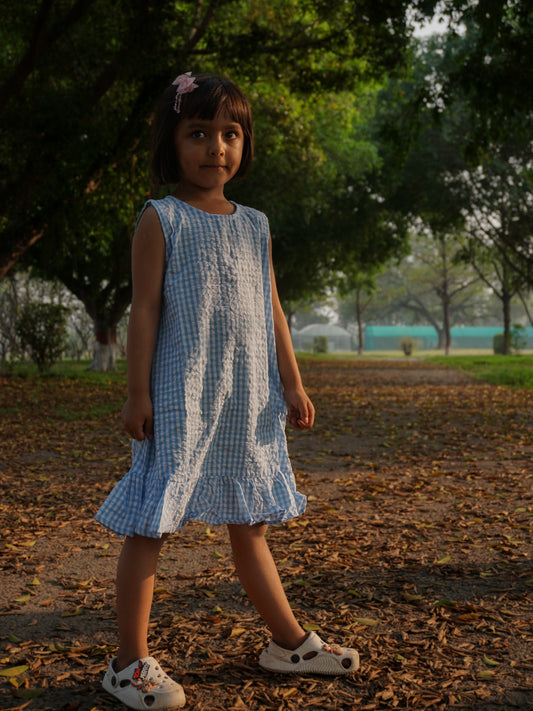
Wild Dahlia Kurta Pajama
Blue print in fine 60s Indian cotton, OEKO-TEX certified fabric, roomy fit for floor-sitting. Sizes 1-2 Y to 7-8 Y.
₹1,099See sizes →
The 12-point checklist before you buy
Save this for any traditional dress for your baby boy, from any shop.
- Fabric is pure cotton, not polyester, art silk or tissue.
- The label or listing names the cotton or weave (for example 60s cotton or poplin), not just "soft fabric".
- Fabric is OEKO-TEX certified, ideally to Product Class 1 for under-3s.
- No beads, mirrors, sequins or loose trims he can pull off.
- No zari or metallic thread on the inside of the neck or underarm.
- The neck opening passes over his head easily.
- Sleeves are 3/4 or short, not long with tight cuffs.
- Kurta ends around mid-thigh for crawlers, just above the knee for walkers.
- Pajama is pull-on with room for a nappy; no drawstring he can chew or pull out.
- Inside seams feel smooth at the neck and underarm.
- Size chosen by his height, with the bigger size if he is in between.
- The outfit can be machine washed at home after the function.
Frequently asked questions
What is the traditional dress for a baby boy in India?
The most common traditional dress for a baby boy across India is a cotton kurta with a pajama. Regional alternatives include a pre-stitched dhoti kurta in North and East India, a veshti or pancha with a shirt in Tamil Nadu, Andhra Pradesh and Karnataka, and a mundu in Kerala. For babies under 3, a kurta pajama is the easiest to wear for a full day.
Which kurta is best for a 1 year old baby boy?
A short, soft cotton kurta that ends around mid-thigh, with an easy neck opening, 3/4 sleeves and a pull-on pajama with room for a nappy. Avoid embellishments he can pull off. Our 1-2 Y kurta measures 16.5 inches long, which suits most boys between about 76 and 88 cm tall.
Is a white kurta pajama a good choice for a baby boy?
Yes, for pujas, naming ceremonies, Eid, Pongal and family photos. White shows marks faster, so pack a spare kurta or pair it with a coloured set for food-heavy functions. A smooth poplin or fine cotton white kurta washes back to clean more easily than a textured one.
Should I buy a traditional dress one size bigger for my baby?
If he is between sizes, yes. Babies grow quickly and a slightly longer kurta can be worn again at the next season's functions. Do not size up by two sizes, though: a kurta that reaches his knees will trip a new walker.
Can a baby wear a cotton kurta in winter?
Yes. Add a thin full-sleeve vest underneath and a sweater or jacket on top for cold evenings, plus socks and a cap. Take the outer layer off indoors so he does not overheat.
Can a baby girl wear the same kurta pajama?
Yes. Our kurta pajamas are made for baby boys and girls. Pastel shades such as Soft Rosé are popular for girls, and white and yellow suit everyone.
Dress him for the whole function, not just the photo
Fine cotton kurta pajamas for baby boys and girls, made in our own unit in Tiruppur, sizes 1-2 Y to 7-8 Y. Browse every colour in our kurta pajama for kids collection, including the softer Soft Rosé set.
See all kurta pajamas →100% cotton · 7-day returns · Free shipping · COD on orders under ₹5,000
Tags:
Previous
Gift for 1 Year Baby Girl: Useful Ideas Under ₹500, ₹1,000 and ₹2,000, Frock vs Co-ord and the Right Size
Next
Christmas Dress for Baby Boy: 7 Red and Green Cotton Outfit Ideas for School, Church and Parties (1 to 8 Years)