
What Is French Terry Fabric? A Manufacturer's Guide to French Terry for Kids
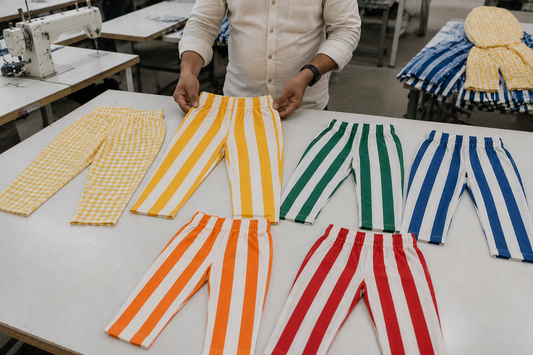
As a manufacturer of children's clothing, French terry is one of the fabrics we keep coming back to at Gozi. We make a number of our kids' garments from French terry, including cotton pants, joggers, shorts, sweatshirts and co-ord sets. We like it because it gives us something that is not always easy to achieve in children's clothing: a fabric that feels substantial and premium without becoming unnecessarily heavy.
There is also something special about a well-made French terry garment. The outside has a clean, smooth appearance, while the inside has its characteristic soft loops. When you combine that construction with good-quality cotton yarn, the result has what we would describe as a luxurious hand feel — soft against the skin, comfortable to move in and substantial enough to feel like a quality garment.
For our French terry garments, we pay particular attention to the yarn as well as the fabric construction. We use Red Label combed compact yarn, because we believe the quality of the yarn is an important part of the final fabric's feel and appearance.
This is also why we think French terry deserves more attention from parents. It isn't simply a "winter fabric" or a "sweatshirt fabric". Depending on its weight and construction, French terry can be used for pants, shorts, sweatshirts, joggers and everyday children's clothing across different seasons.
In this guide, we'll explain what French terry actually is, how it is constructed, why it feels so soft, how it compares with fleece and regular jersey, and what we look for as a manufacturer when selecting French terry for children.
What Is French Terry Fabric?
French terry is a knitted fabric with two noticeably different sides.
The outer surface is generally smooth, while the inside has small, soft loops of yarn. These loops are one of the defining characteristics of French terry.
This construction is different from fleece. Fleece is usually brushed on the inside, creating a fuzzy surface designed to trap more air and provide greater warmth. French terry retains its loops rather than brushing them into a fluffy surface.
The result is a fabric that can offer a useful middle ground:
-
Softer and more substantial than a very lightweight jersey
-
Less bulky and generally more breathable than heavy fleece
-
Comfortable against the skin
-
Flexible enough for active children
-
Available in different weights for different uses
The exact characteristics of French terry can vary depending on the yarn, knitting construction, GSM, finishing and fibre composition. So when someone says simply "French terry", that doesn't tell you everything about the garment.
The yarn and the way the fabric is made matter just as much.
How Is French Terry Constructed?
To understand why French terry feels different from other fabrics, it helps to understand the basics of knitting.
French Terry Is a Knitted Fabric
Unlike woven fabrics, where yarns are arranged in crossing horizontal and vertical directions, knitted fabrics are made by forming interconnected loops.
This gives knitted fabrics an inherent flexibility that is particularly useful in children's clothing.
Think about what a child does in a normal day:
They sit on the floor.
They crawl.
They run.
They climb.
They jump.
They bend.
They stretch.
They lie down.
A fabric that has some natural flexibility is therefore extremely useful for children's everyday clothing.
The Smooth Outside and Looped Inside
The defining visual feature of French terry is the difference between its two sides.
Outside: relatively smooth and clean.
Inside: made up of small loops.
These loops contribute to the characteristic hand feel of French terry and help distinguish it from fabrics such as ordinary jersey and brushed fleece.
The looped construction also gives French terry a little more body than a lightweight T-shirt jersey.
That additional body is one of the reasons we particularly like it for children's pants and joggers.
French Terry Knit Types: Why Construction Matters
"French terry" describes a family of knitted fabrics rather than one single fabric specification.
Different manufacturers can produce French terry with differences in:
-
Yarn
-
Yarn count
-
Knitting construction
-
GSM
-
Loop size
-
Fabric density
-
Stretch
-
Finishing
This is important when comparing two French terry garments.
A 180 GSM French terry and a 240 GSM French terry may both be called French terry, but they won't necessarily feel or perform in exactly the same way.
At Gozi, for example, our French terry garments include 240 GSM constructions. That gives the fabric enough body for products such as kids' pants, shorts and sweatshirt sets while retaining the soft, looped character that makes French terry comfortable.
So we always recommend that parents look beyond the fabric name and ask:
What yarn is being used? What is the GSM? What is the construction? And how does the finished fabric actually feel?
Why Does French Terry Feel So Soft?
For us, softness is one of the biggest reasons for choosing French terry for children's clothing.
Children don't experience a fabric through its technical specifications.
They experience it through how it feels.
A parent might see "240 GSM cotton French terry" on a product description. A child simply knows whether the pants feel comfortable or scratchy.
And that distinction matters.
The Yarn Makes a Difference
The quality of the yarn going into the fabric has a major influence on the final hand feel.
At Gozi, we use Red Label combed compact yarn for our French terry garments.
What does combed yarn mean?
Combing is a process used to remove shorter fibres and impurities from cotton before spinning the yarn. The resulting yarn can have a cleaner and more uniform character.
What does compact yarn mean?
Compact spinning is a yarn-spinning process designed to reduce fibre protrusion and produce a more compact yarn structure.
In simple terms, starting with a cleaner, more controlled yarn helps us work towards the smooth and refined fabric feel we want.
For us, this is important because "100% cotton" alone doesn't tell the entire story.
Two fabrics can both be labelled 100% cotton and still feel very different because of differences in yarn quality, spinning, knitting and finishing.
Why French Terry Has a Luxury Feel
We often use the word luxurious when describing a good French terry garment, but we don't mean that it needs to be heavy or expensive.
A premium feel comes from several things working together:
-
Quality cotton yarn
-
Clean yarn construction
-
Good knitting
-
Consistent fabric density
-
Appropriate GSM
-
Good finishing
-
Careful garment construction
The combination creates a fabric that feels soft, substantial and refined without feeling unnecessarily bulky.
This is one reason we enjoy working with French terry. It allows us to make everyday children's clothing that still feels special when you pick it up.
Our French terry collection includes pants and joggers, while we also use the fabric in products such as sweatshirt and jogger sets. The same basic fabric family can therefore be used across very different types of children's clothing.
Why Is French Terry Good for Kids' Clothing?
There isn't one perfect fabric for every child, season or climate. But French terry has several characteristics that make it particularly useful for children's clothing.
1. Softness
This is the first reason we choose it.
The looped inner surface can feel soft and comfortable against the skin, particularly when made with good-quality cotton yarn and finished properly.
For children who spend hours wearing the same clothes while playing, travelling or relaxing, this matters.
2. Comfortable for Movement
French terry is knitted rather than woven, giving it a degree of flexibility.
That makes it well suited to:
-
Running
-
Playing
-
Crawling
-
Climbing
-
Travelling
-
Sitting
-
Lounging
This is why we particularly like it for children's pants, joggers and shorts.
3. Breathability
Cotton French terry can offer a useful balance between comfort and warmth.
The looped construction is different from the dense, brushed interior of fleece, and lighter French terry can be comfortable in moderate weather.
Of course, breathability depends on the complete fabric specification, including fibre, GSM and construction.
4. Warmth Without Excessive Bulk
A medium-weight French terry can provide more warmth and structure than a lightweight jersey without feeling like a heavy winter fabric.
That makes it useful for:
-
Mild winters
-
Cool evenings
-
Travel
-
Layering
-
Indoor environments
-
Transitional seasons
5. Versatility
This is perhaps our favourite characteristic.
The same fabric family can be used to make:
-
Cotton pants
-
Joggers
-
Shorts
-
Sweatshirts
-
Sweatshirt sets
-
Co-ord sets
-
Everyday casual clothing
That versatility is valuable to us as manufacturers because we can design different garments around the same fundamental comfort characteristics.
French Terry vs Fleece vs Regular Jersey
This is one of the easiest ways to understand where French terry fits into children's clothing.
| Feature | French Terry | Fleece | Regular Jersey |
|---|---|---|---|
| Warmth | Medium | High | Low–Medium |
| Breathability | Generally high | Generally medium | Generally high |
| Softness | Very soft | Very soft | Soft |
| Best season | Mild winter, transition seasons & layering | Cold winter | Summer & warm weather |
| Pilling tendency | Generally lower than brushed fleece, depending on quality | Can be higher because of the brushed surface | Low–moderate, depending on yarn and finishing |
These are general comparisons, not specifications that apply to every fabric sold under these names.
GSM, yarn quality, fibre composition, knitting construction and finishing can significantly change the performance of a fabric.
In simple terms:
Jersey: light and ideal for T-shirts and warmer weather.
French terry: the versatile middle ground — soft, structured, breathable and useful for layering.
Fleece: warmer and more insulating, particularly useful for colder weather.
This is why we don't see French terry and fleece as interchangeable fabrics. They solve slightly different problems.
Undyed Cotton Base: What Does It Mean?
One of the details that makes some of our French terry garments different is the undyed cotton base.
Some of our French terry pants are constructed from an undyed cotton base, with the print or colour applied to the outer face. This means the inner looped surface that sits against the child's skin remains the prepared but undyed cotton base.
We think this is worth explaining because parents often focus on the colour and print on the outside without thinking about what is actually touching their child's skin.
For these garments, our approach is simple:
The outside can have the colour or print. The inside remains the undyed cotton surface.
We don't describe this as making the garment "hypoallergenic", because that would be an inappropriate medical claim. An undyed cotton surface does not guarantee that a child will have no skin reaction.
What we value is the simplicity of the cotton surface against the skin and the soft hand feel it provides.
What About Dyeing and Printing?

The quality of the finished garment isn't just about the cotton yarn and knitting.
What happens after the fabric is knitted matters too.
For our printing and dyeing requirements, we use GOTS-certified printing and dyeing processes/facilities where applicable.
This is an area where we believe manufacturers should be precise about their claims.
A fabric being processed at a GOTS-certified facility does not automatically mean that every finished garment is itself GOTS-certified. The exact certification depends on the scope of the certification and the specific supply chain.
For us, the important point is that we pay attention not just to the yarn and knitting, but also to how the fabric is processed and finished.
When Should Kids Wear French Terry?
French terry is particularly versatile for children between 1 and 6 years, although the same fabric can of course be used for older children as well.
Daily Wear
French terry pants and shorts can work extremely well for everyday activities because they combine comfort with enough structure to look like a proper outfit.
Playgroup and Playtime
The soft, flexible construction is well suited to active children.
Travel
French terry can be especially useful when temperatures change during a journey.
A pair of comfortable French terry pants can work for a car journey, flight or holiday without feeling as restrictive as some structured woven trousers.
Winters in the Plains
In parts of India where winters are cool rather than extremely cold, medium-weight French terry can work very well.
It can be worn on its own or layered with other garments.
Layering in the Hills
For colder hill climates, French terry works better as one layer in a clothing system rather than being treated as a substitute for every warm layer.
For example:
T-shirt → French terry sweatshirt → jacket
The exact combination depends on the temperature and the child's activity level.
Can Kids Wear French Terry in Summer?
Yes — but the weight of the fabric matters.
A lightweight French terry can be comfortable in moderate summer weather, particularly for evenings, travel or air-conditioned environments.
However, when temperatures become extremely hot and humid, a lightweight cotton jersey may be a better choice.
This is another reason we don't believe that saying simply "French terry is good for all seasons" tells the whole story.
The GSM matters.
A lighter French terry and a heavier French terry can behave very differently.
How to Choose a Good French Terry Garment
If you're shopping for French terry clothing for your child, here is the checklist we would recommend.
1. Check the Fibre Composition
If you prefer natural fibres, look for 100% cotton French terry rather than assuming every garment labelled French terry is cotton.
2. Check the GSM
GSM means grams per square metre and gives you an indication of the fabric's weight.
Generally:
Lower GSM = lighter fabric
Higher GSM = heavier fabric
But don't assume that higher GSM automatically means higher quality.
A good fabric is about finding the right combination of yarn, construction, GSM and finishing for its intended use.
3. Feel the Loops Inside
Turn the garment inside out.
Feel the looped surface.
Are the loops reasonably even?
Does the fabric feel soft?
Does the inside feel comfortable rather than rough?
This simple test can tell you quite a lot.
4. Look at the Outer Surface
The outer face should have a reasonably consistent appearance.
Look for:
-
Uneven areas
-
Visible knitting defects
-
Excessive fuzziness
-
Irregularities
-
Poor finishing
5. Check the Stitching
Fabric quality is only one part of a good garment.
Look at:
-
Side seams
-
Crotch seams
-
Shoulder seams
-
Pocket attachment
-
Hemming
-
Overall stitch consistency
6. Check the Waistband
For children's pants and joggers, the waistband is particularly important.
It should hold the garment securely without being unnecessarily tight.
A comfortable waistband can make the difference between a pair of pants a child happily wears and one they keep trying to pull off.
7. Check the Care Label
Good fabric still needs appropriate care.
Check the washing instructions before buying, especially if you're looking for something that will be washed frequently.
What Goes Into a Gozi French Terry Garment?
This is the part of manufacturing that most customers never see.
For us, a French terry garment isn't simply:
Buy fabric → cut → stitch → sell.
There are several decisions before a garment reaches a child.
1. Yarn Selection
We use Red Label combed compact yarn for our French terry garments.
The yarn is one of the foundations of the final fabric.
2. Knitting
The yarn is knitted into French terry, creating the smooth face and characteristic looped inner surface.
3. Undyed Cotton Base
For our French terry garments with an undyed base, the cotton inner surface remains undyed while the outer face can subsequently receive colour or print.
4. Printing and Dyeing
Where applicable, we use GOTS-certified printing and dyeing processes/facilities for the required colour and print work.
5. Finishing
The fabric goes through the required finishing processes to achieve the desired hand feel, dimensions and fabric characteristics.
6. Cutting and Stitching
The finished fabric is cut into individual garment panels and stitched into pants, shorts, sweatshirts, joggers or sets.
7. Quality Checking
We check the finished garments for things such as:
-
Stitching
-
Measurements
-
Fabric defects
-
Construction
-
Overall appearance
-
Hand feel
That manufacturing process is a big part of why we are particular about the fabrics we choose.
How to Care for French Terry Kids' Clothing
French terry is practical, but cotton still needs sensible care.
Wash inside out
Turning the garment inside out can help protect the outer surface and prints during washing.
Use cold or normal-temperature water
Avoid unnecessarily hot water.
Avoid high heat
High heat can contribute to cotton shrinkage and can affect the fabric and garment over time.
If using a dryer, avoid high-temperature drying.
Expect some initial shrinkage
Cotton can shrink, particularly when exposed to high heat.
Good fabric finishing can reduce shrinkage, but it is better not to assume that cotton garments will never shrink.
At Gozi, some of our French terry garments are compacted and pre-shrunk as part of the manufacturing process, and specific products may have their own shrinkage specifications.
Always follow the care instructions supplied with the individual garment.
Don't use unnecessarily harsh washing
A gentle wash and sensible drying routine will generally help children's cotton clothing stay comfortable for longer.
French Terry for Kids: What We Look For as Manufacturers
After working with children's clothing, we've learned that a fabric's label only tells part of the story.
When we select French terry, we think about the complete combination:
Yarn quality
↓
Knit construction
↓
GSM
↓
Softness
↓
Finishing
↓
Garment construction
↓
How the finished garment feels on a child
For us, that's the real test.
A fabric can look beautiful on a roll in a textile market. But the more important question is:
How will it feel when a three-year-old wears it for eight hours, plays in it, sits on the floor in it and then asks to wear it again tomorrow?
That is the standard we try to keep in mind when making children's clothing.
Frequently Asked Questions About French Terry
Is French terry warm enough for winter?
It depends on the fabric's GSM, construction and the weather.
Medium-weight French terry can work very well for mild winters and as a layering piece. In very cold weather, children will generally need additional insulating layers.
Is French terry good for babies with eczema?
French terry can be soft and comfortable, but the fabric alone cannot determine whether it is suitable for a child with eczema.
Children with eczema can have individual sensitivities. Parents should follow their paediatrician or dermatologist's advice and check the complete fibre composition, dyes, finishes and care instructions of the garment.
We would not describe French terry, or any other fabric, as a treatment or cure for eczema.
Does French terry shrink?
Cotton French terry can experience some initial shrinkage.
The amount depends on the cotton, knitting, finishing and washing conditions. Proper fabric finishing can reduce shrinkage, while high heat can increase it.
Always follow the care label.
Is French terry the same as fleece?
No.
Both are commonly used for sweatshirts and children's winter clothing, but their constructions are different.
French terry has loops on the inside. Fleece generally has a brushed, fuzzy interior.
French terry is therefore usually a better choice when you want a balance between softness, breathability and moderate warmth. Fleece is generally chosen when greater warmth and insulation are the priority.
Can kids wear French terry in summer?
Yes, particularly lighter-weight French terry.
However, for extremely hot and humid weather, a lightweight cotton jersey may be more comfortable.
The fabric's GSM, construction and the child's activity level all matter.
Final Thoughts: Why We Keep Coming Back to French Terry
As manufacturers, we work with many different fabrics.
Each one has its place.
But French terry is one of those fabrics we keep returning to because it gives us so much flexibility. We can use it to make comfortable cotton pants, shorts, joggers, sweatshirts and coordinated sets while maintaining the soft, substantial feel that we want in children's clothing.
For us, the attraction isn't simply that French terry is fashionable.
It is the combination of good-quality cotton yarn, a comfortable knitted construction, softness, versatility and a premium hand feel.
And ultimately, that's what matters when making clothes for children.
We want a child to put on a pair of pants or a sweatshirt and simply get on with being a child — running, playing, travelling, climbing, laughing and getting them dirty.
That's what we think good children's clothing should allow them to do.
Explore Gozi's French Terry Collection
If you're looking for French terry clothing for children, you can explore our French Terry pants and joggers, French Terry shorts and French Terry co-ord sets.
Tags: