
How Indian Cotton Pants Are Made: From Yarn to Your Child's Wardrobe
Where Your Child's Cotton Pants Actually Come From
Most parents who buy cotton clothing for their children have never thought about what happens before the garment reaches their hands. The journey from raw cotton to a finished pair of kids' pants involves a chain of decisions at every step — about fibre quality, spinning, weaving, dyeing, cutting, stitching, and finishing — and each of those decisions is made by human beings in manufacturing facilities across India.
We think this journey is worth understanding. Not as a marketing exercise, but because understanding how clothes are made changes how you evaluate what you are buying and whether it represents genuine value. Here is an honest account of how Indian cotton pants for kids are made.
Step 1: Cotton Fibre Sourcing
India is one of the world's largest cotton-producing countries. Cotton is grown primarily in Maharashtra, Gujarat, Telangana, Andhra Pradesh, and parts of Punjab and Haryana. The fibre quality varies significantly by region, growing conditions, and whether the cotton is long-staple, medium-staple, or short-staple.
Long-staple cotton produces finer, stronger yarn. It is more expensive and used for premium fabrics. Short-staple cotton is cheaper and produces coarser yarn. Most budget kids' clothing in India uses short-staple cotton because it reduces raw material cost significantly.
At Gozi, we source medium-to-long-staple cotton for our pants range. The staple length directly affects the yarn count we can achieve and the final softness of the fabric. You cannot make 30s combed cotton from short-staple fibre.
Step 2: Ginning and Cleaning
Raw cotton from the field contains seeds, leaf fragments, dirt, and moisture. Ginning removes the seeds. Cleaning passes the raw lint through a series of mechanical processes to remove impurities and open up the fibre bundles. The quality of cleaning at this stage affects both the final yarn quality and the dye uptake of the fabric — poorly cleaned cotton dyes unevenly.
Step 3: Carding and Combing
This is where combed cotton and standard cotton diverge. Carding aligns the fibres roughly and removes the largest impurities. Standard cotton is spun after carding. Combed cotton goes through an additional combing process that removes short fibres and further aligns the long fibres in parallel. The combing stage adds cost and processing time but produces a fundamentally better yarn.
For a toddler's cotton pants meant to be worn against skin for eight-plus hours a day, the difference between combed and standard cotton at this stage translates into the difference between comfortable and irritating wear over months of use.
Step 4: Spinning
Combed and carded fibre is drawn out and twisted into yarn on spinning machines. The yarn count — the fineness of the resulting thread — is determined at this stage. Our 30s yarn is spun to a specific twist count and fineness. The twist matters as much as the count: under-twisted yarn is weak and pills easily. Over-twisted yarn feels wiry. Getting the twist right for a specific count and end use is a skill that varies between spinning mills.
Step 5: Knitting or Weaving
Yarn becomes fabric through either knitting (interlocking loops) or weaving (interlacing threads). Our French Terry pants use knitted fabric — the looped interior characteristic of French Terry is created by the knitting process. Our check and gingham pants use woven fabric, where the pattern is created by the crossing of differently coloured warp and weft threads.
Woven gingham is the correct construction for check patterns because the colour is genuinely part of the structure, not printed on top. A printed check can only approximate the visual quality of a woven one, and it lacks the colour durability of yarn-dyed woven construction.
Step 6: Dyeing and Finishing
For our check and gingham pants, the yarn is dyed before weaving — this is called yarn dyeing and it gives the most colour-consistent results. For our French Terry pants, the outer stripe is applied to the finished fabric. The inner layer is left undyed.
After dyeing, fabric goes through finishing processes including biowashing — an enzyme wash that removes surface fibre ends, softens the hand feel, and removes residual processing chemicals. This is the stage that gives our cotton the softness that parents comment on when they first hold our products.
Step 7: Cutting and Stitching
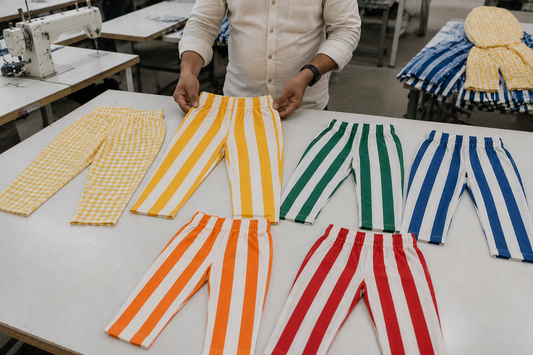
Fabric rolls come to our cutting floor, where patterns are laid and fabric is cut to size. Panels are stitched together by experienced operators. The waistband elastic is inserted and sewn into a channel. The hem is finished. Every pant goes through a quality check before it is folded and packed.
Browse the finished result in our cotton pants collection for kids.
Frequently Asked Questions
Is all cotton sold in India actually grown in India?
Most of it, yes. India is one of the world's top three cotton producers. However, some premium long-staple cotton, particularly Egyptian or Pima, is imported for high-end fabric production. Our cotton is domestically sourced.
What is biowashing and is it safe for babies?
Biowashing uses natural biological enzymes — not harsh chemicals — to process the fabric surface. It is safe for babies and is specifically used in premium children's and baby clothing because it produces a softer, cleaner fabric surface.
Why does Indian-made cotton clothing vary so much in quality?
Because the production chain has many decision points, and cutting corners at any stage — fibre quality, yarn count, dyeing process, finishing — reduces the final product quality while reducing cost. The price of a garment is usually a reasonable signal of where in this chain compromises were made.
Is manufacturing in India a quality advantage or disadvantage for kids' clothing?
India has some of the world's most skilled cotton textile manufacturing capacity, particularly in Gujarat, Tamil Nadu, and Maharashtra. Indian-made children's cotton clothing from quality manufacturers is genuinely world-class. The challenge for consumers is identifying those manufacturers among the broader market.
Tags:
Previous
Why Relaxed Fit Cotton Pants Are Better for Active Toddlers in India
Next
The Truth About Soft Cotton Labels on Kids' Pants in India