
Cotton Pants for Kids in India: A Manufacturer's Guide to Fabric, Fit and Sizing (6M to 8Y)
The best cotton pants for kids in India are pure cotton, cut in a relaxed fit with a wide elastic waist, and built to suit how your child actually lives: a light woven check or seersucker for the hottest months, and a knitted 240 GSM French terry as the year-round everyday pair. What matters more than the "100% cotton" label is the finishing. Has the fabric been compacted so it will not shrink? Is the colour woven into the yarn or sitting on the surface? And what exactly is touching your child's skin?
This guide answers all of those questions, plus fit, sizing, waistbands, babies, sensitive skin, washing in hard water and buying as a gift. When you are ready to shop, our cotton pants for kids come in sizes from 6 months to 8 years, made in our own unit in Tiruppur.
Shop this guide
 The Mint Gingham Cotton Pants for Kids₹799
 French Terry Dark Green Striped Pants for Kids₹799
 French Terry Yellow Striped Pants for Kids₹799
100% cotton · 7-day returns · Free shipping · COD on orders under ₹5,000
In this guide
- Who we are, and why a manufacturer wrote this
- Key takeaways
- Why do most kids' pants disappoint after three washes?
- What does "100% cotton" actually tell you?
- How are cotton pants made, from fibre to finished pair?
- Why do cotton pants shrink?
- What is biowashing?
- What is actually touching your child's skin?
- Which fit is best for active toddlers?
- What makes a good elastic waistband?
- Do kids' pants need pockets?
- How do you get the size right first time?
- What changes for babies aged 6 to 12 months?
- Which pants suit sensitive skin and heat rash?
- Which pant for which situation?
- Why unisex, and why Indian-made?
- How many pairs, and buying as a gift
- How do you wash cotton pants in Indian conditions?
- What we make
- Frequently asked questions
Who we are, and why a manufacturer wrote this
We're Gozi, a kids' clothing brand from Tiruppur, Tamil Nadu, run by a small team who make the clothes themselves.
That last part is unusual, and it's the reason this guide exists. Most kidswear brands in India are design and marketing operations. They send a tech pack to a vendor, receive finished garments in polybags, and put a label on them. If you ask them what GSM their fabric is, or whether the dye was properly fixed, they have to ask somebody else, and often that somebody has a reason not to tell them.
We own the unit. Twenty-eight machines, our own cutting table, our own quality checks. We choose the yarn, we decide which mill knits or weaves it, we insist the fabric is compacted and biowashed, we sit with the processing house on colour, and we reject lots that don't come back right. We've thrown away entire runs of red because the dye wasn't fixed properly and it would have come off on somebody's bedsheet.
So when this guide tells you what to look for in a pair of kids' cotton pants, it isn't repeating something from a supplier's brochure. It's what we look for ourselves, every week, before anything ships. Everything we make is cotton, for children aged 6 months to 8 years, and our cotton pants are priced from ₹699 to ₹799.
More about us · Our manufacturing details
A note from the founder: why we only make cotton
Let me tell you what changed my mind about this, and it wasn't a study.
A few years ago I ended up wearing a polyester t-shirt for about half a day, one of those situations where it was what I had. By the afternoon I was genuinely uncomfortable. Not sweaty in the normal way. Something closer to suffocated. The fabric had stopped letting anything through, and the sweat had nowhere to go, so it just sat there between the cloth and my skin. I remember thinking very clearly: I am an adult, I can take this shirt off whenever I want, and I still can't wait to get out of it.
Then think about a three-year-old in a Delhi May. Same fabric, hotter day, more running around. And no vocabulary for what's wrong. They can't say "this fabric isn't breathing." They just get irritable and scratchy and nobody connects it to what they're wearing.
Here's the part that convinced me it isn't just me. I have kids. When I put a cotton pant and a poly-blend pant in front of them and let them pick, they pick cotton. Every single time. Nobody taught them the difference and nobody told them which one their father makes. Small children are ruthlessly honest about physical comfort, and they vote with their hands.
Most kidswear sold in India today is polyester or a poly-cotton blend. Polyester is cheaper, doesn't shrink and survives a warehouse. Those benefits go to the seller, not the child wearing it.
I want to be careful about the research, because there's a lot of exaggeration online. The solid part is thermal. A review of clothing studies by Canada's National Collaborating Centre for Environmental Health describes a wear trial at 37°C and 60% relative humidity, which is simply an Indian summer afternoon, where local sweating and thermal stress were higher in polyester than in cotton, and the extra sweat did not cool the body any better. In a separate, milder trial, people in polyester had higher pulse rates, bigger changes in core temperature and felt wetter than the same people in cotton.
The body works harder, sweats more, and gets no cooling benefit for it. That is a fairly precise description of what I felt that afternoon, and adults cope with heat better than small children do. So we don't make it. Not as a blended fabric, not as a cheaper line, not in a pocket lining. If you want the full fabric comparison, we've written it up separately: cotton vs polyester pants for kids in Indian summer.
Founder, Gozi Lifestyle Pvt. Ltd.
Key takeaways
- Construction matters more than the fibre label. Woven gingham, checks and seersucker are light and crisp for peak summer. Knitted French terry is the all-rounder you can wear through the year.
- French terry is not fleece. Ours is 240 GSM with soft, uncut loops on the inside. It is not brushed and not a winter-only fabric.
- Shrinkage is a finishing problem. Pants shrink because the mill skipped compacting, not simply because "cotton shrinks." Our fabric is compacted, and residual shrinkage is under 5% in our own testing.
- Biowashing gives lasting softness by removing surface fuzz with enzymes, instead of coating the fabric with a softener that rinses out.
- Know what touches the skin. Our woven checks have the colour woven into the yarn; our French terry stripes sit on the outer face only, and the looped side against the skin is undyed.
- Fit is half the comfort. A relaxed cut with a wide elastic waist lets Indian kids squat, crawl and sit cross-legged, and keeps air moving around the legs.
- Measure, don't trust the age label. Two four-year-olds can be several centimetres apart at the waist.
- Wash cold, dry in shade, and use a vinegar rinse if your water is hard.
Why do most kids' pants in India disappoint after three washes?
Read the reviews on almost any budget listing for kids' cotton pants and you'll see the same three complaints, over and over: the stitching came apart, the size was wrong, and the fabric wasn't what the photo showed.
That isn't bad luck. It's what happens when a garment is costed backwards from a price point. Somebody decided the pant had to land at ₹135, and then every decision after that, from yarn quality, fabric finishing and dye fixing to thread, elastic and stitching time, was made to protect that number.
Because we make the pants ourselves, we see where those decisions get made. Almost every complaint a parent has about cotton pants traces back to one of a handful of steps: the fibre and yarn, the finishing (compacting and biowashing), the dyeing, the cut, and the waistband. The rest of this guide walks through each one, and what you can check as a buyer.
What does "100% cotton" actually tell you?
Almost nothing on its own. It's true of a stiff, scratchy pant that pills in a month and equally true of one that gets softer for two years. Here is what separates them.
Combed vs carded cotton
Raw cotton fibres come in a range of lengths. Carding cleans and aligns them but leaves the short fibres in. Combing goes a step further and removes them. Those short fibres are what work their way to the surface with wear and ball up into pills. A carded cotton pant looks fine in the photo and looks fuzzy after six weeks of school. We use combed compact yarn, which is smoother and stronger than standard carded cotton and is why our fabric resists pilling. If you want the detail, read our guide to what combed cotton means.
Staple length: why the fibre itself matters
Tiruppur sits at the end of a supply chain that runs up through Coimbatore's spinning mills and out to the cotton belts of Gujarat, Maharashtra and Telangana. Not all of that cotton is equal. Long-staple cotton, the kind with longer individual fibres, spins into a smoother, stronger yarn. It costs meaningfully more per kilo than the short-staple stock that goes into cheap kidswear, and the difference never shows up in a product photo. It shows up in month three, when one pant is still smooth and the other has gone fuzzy at the seat.
Woven vs knit: two completely different fabrics
This is the distinction that matters most, and almost nobody explains it to parents. Both are 100% cotton. They are made in different ways and behave differently.
Woven fabric has threads crossing over and under each other at right angles, on a loom. It is crisp, structured and breathable, with barely any stretch. Our gingham and check pants are woven. Air moves straight through, it doesn't cling, and it dries fast after a monsoon soaking.
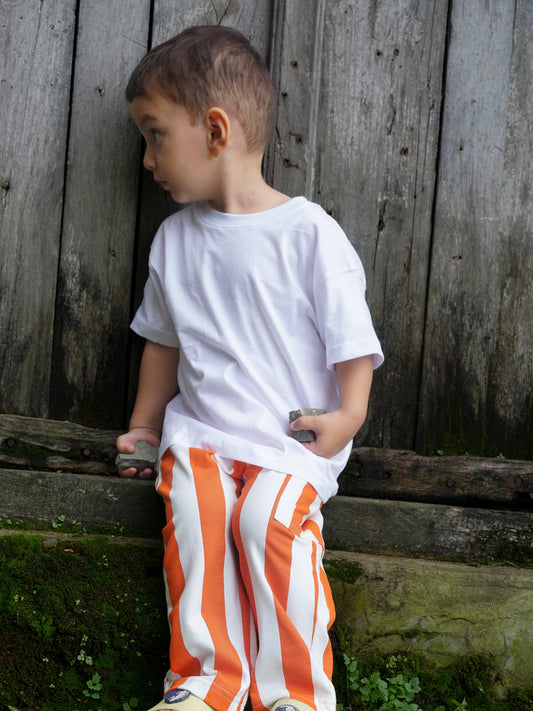
Knit fabric is a yarn looped through itself, like a jumper. It is soft, stretchy and forgiving, so it moves with your child when they squat, climb or sit cross-legged. Our striped pants are knitted French terry: a smooth outer face with soft, uncut loops on the inside.
A word on French terry, because it gets misunderstood. People hear 240 GSM and picture something heavy and wintry. It isn't. French terry is not fleece. Fleece is brushed: the loops are cut open and raked up into a fuzzy pile, which is what makes fleece hot. French terry leaves the loops intact. The result is a fabric with a bit of substance, but with air still moving through it. It works on a cool December morning in Chandigarh and in an air-conditioned classroom in June. Our manufacturer's guide to French terry goes deeper.
If you only remember one thing: woven checks when it's genuinely hot, French terry for everything else.

Woven checks in the lower left, knitted French terry stripes across the rest. Same fibre, two completely different fabrics.
The video below shows the French terry loopback up close. This is the side that sits against your child's leg.
What GSM means, and how our fabrics compare
GSM is grams per square metre: simply how much fabric there is per unit of area. Higher GSM means a denser, warmer, more opaque fabric. It's one of the most useful numbers on a spec sheet, and very few Indian kidswear brands publish it. Our explainer on what GSM means in fabric covers the right GSM for different kids' clothes.
| Our fabric | Construction | How it feels | Best for |
|---|---|---|---|
| Gingham and check | Woven, check woven into the cloth | Light, crisp, doesn't cling | Hot, humid days, playschool, everyday summer wear |
| Seersucker | Woven, puckered texture | Sits slightly off the skin, needs no ironing | Peak summer and travel; our lightest option |
| Cotton lounge pants | Pure cotton, soft pull-on | Easy and relaxed | Home, naps, lazy weekends |
| Striped French terry | Knit, 240 GSM, looped undyed inner face | Smooth outside, soft looped inside | All year: school, play, AC rooms, cooler evenings, North Indian winters |
They aren't competing. The woven pants are hot-weather specialists. French terry is the pair that stays in rotation twelve months a year, which is why, if you're only buying one, we'd point you at that one.
How are cotton pants made, from fibre to finished pair?
A pair of kids' pants passes through a long chain of decisions before it reaches you, and each one is a place where quality is either protected or quietly cut. Knowing the chain helps you judge what a price is actually paying for.
| Stage | What happens | Where corners get cut |
|---|---|---|
| Fibre | Cotton is grown, mainly in Maharashtra, Gujarat and Telangana, and graded by staple length | Short-staple fibre is cheaper but gives a coarser, weaker yarn |
| Ginning and cleaning | Seeds, leaf and dirt are removed and the fibre is opened up | Poorly cleaned cotton dyes unevenly |
| Carding and combing | Fibres are aligned; combing also strips out the short ones | Skipping combing saves cost and leaves the fibres that pill |
| Spinning | Fibre is drawn and twisted into yarn of a set fineness | Under-twisted yarn is weak and pills; over-twisted yarn feels wiry |
| Knitting or weaving | Yarn becomes knit (loops) or woven (crossed threads) fabric | Printing a "check" onto plain cloth instead of weaving it |
| Dyeing and finishing | Colour is applied and fixed; fabric is compacted and biowashed | Short washing baths leave loose dye; skipping compacting causes shrinkage |
| Cutting and stitching | Panels are cut, sewn, waistband elastic inserted, hems finished, checked | Narrow elastic, weak seams at the crotch, no final quality check |
Every step after the yarn is visible to us on our own floor in Tiruppur, which is why the next few sections focus on the ones that cause the most complaints: shrinkage, softness and colour.
Why do cotton pants shrink?
Here's the thing that frustrates parents most, and the explanation is almost never given honestly. Your child's pants didn't shrink just because cotton shrinks. They shrank because the fabric was never relaxed before it was cut.
When cotton is knitted, the yarn is under tension. The fabric comes off the machine stretched, and it stays stretched until the first time it gets wet and warm, at which point the fibres relax back to their natural length. If nobody forced that relaxation at the mill, it happens in your washing machine, and the pant that fit in October is a capri by January.
The process that prevents this is called compacting. The fabric is deliberately shrunk under controlled steam and pressure before cutting, so most of the movement has already happened. Compacting costs money and takes time, and it's the first thing cut from a ₹135 pant.
What to ask as a buyer: what is your shrinkage tolerance? If a brand can answer with a number, they know their supply chain. If they say "cotton shrinks, that's normal," they don't. Our fabric is compacted and biowashed before cutting, and residual shrinkage is under 5% in our own wash tests, so the fit you buy is the fit you keep. Washing in cold water helps further.
What is biowashing, and why does it matter?
Pick up a cheap cotton t-shirt and run your palm across it. There's a faint fuzz: a haze of tiny fibre ends standing up off the surface. That fuzz is why cheap cotton feels slightly rough on day one and looks pilled and tired by month three. Those loose ends are exactly what tangles into little balls with friction.
Biowashing removes them before the garment is made. Cellulase enzymes are introduced in a controlled wash and digest just the protruding surface fibres, leaving the body of the yarn intact. Here's what that means for a child's pant:
- Soft from the first wear. No breaking-in period.
- Far less pilling, especially at the seat and inner thighs, the two places kids' pants always pill first.
- Clearer colour. Surface fuzz scatters light and makes fabric look dusty; take it off and colour reads sharper for longer.
- Fewer loose fibres against skin, which gives a child who scratches at clothing less to react to.
- It is not a softener. Fabric softeners coat fibres in a residue that washes out, taking the softness with it and reducing breathability while it's there. Biowashing changes the fabric itself, so the softness stays.
It's an extra step, it costs money, and it's invisible in a product photograph, which is precisely why most kidswear at budget prices skips it.
What is actually touching your child's skin?
Your child wears these pants for twelve hours at a stretch, in Indian heat, sweating. Whatever is on the inside surface of the fabric is in contact with their skin that whole time. It's worth being specific.
Why your child's red pants stained the bedsheet
It's almost always a red, a navy or a bright orange. The technical term is rub fastness: how well a dye stays put when the fabric is rubbed, tested dry and wet. Wet rub fastness is where cheap dyeing falls apart, and sweat, humidity and a child sitting on a white bedsheet in a Delhi July are all a wet rub test.
The cause is unfixed dye. In reactive dyeing the dye is meant to bond with the cotton fibre, and the unbonded surplus is washed out in a series of soaping baths. Skip or shorten those baths and the surplus stays loose on the surface. Deep reds are the hardest to get right, and we've rejected and re-processed red lots ourselves over this.
Home test: rub a slightly damp white cloth firmly across the darkest part of a new garment. If the cloth picks up colour, wash that garment separately for its first several washes. A small release of colour in the very first wash can happen even with good woven fabric; colour that keeps coming off wash after wash is a dyeing problem.
Woven checks: the colour is in the yarn
A printed check is woven white and then has colour applied to the surface with a binder, so the pattern sits on top of the cloth. That's why prints crack, fade and go patchy. In our gingham and check pants the check is woven into the cloth: a coloured thread crosses a white one, which is why the check stays crisp wash after wash.
A simple test with any checked garment: look at the reverse. When the check is woven in, the pattern is as clear on the back as on the front. When it's printed, the back is pale, blurred or plain white.

Woven gingham. The check exists because a coloured thread crosses a white one.
French terry stripes: undyed on the inside
Turn one of our striped French terry pants inside out. The stripe sits on the outer face only. The looped side against your child's leg is RFD cotton, which stands for "ready for dyeing": it has been prepared but never dyed. You can see the outer colour only faintly, showing through from the other side.

The inside of a red striped French terry pant. The loops touching the skin are undyed; the red you can see is the outer face showing through.
This isn't a claim you have to take on trust. It's in the photograph above and in the video, and you can check it on any pair the day it arrives.
What an OEKO-TEX label means
You'll see OEKO-TEX mentioned on some kidswear, including on the product pages of our woven gingham, check and lounge pants, which are OEKO-TEX Standard 100 certified. Under the OEKO-TEX Standard 100 scheme, every component of a certified item, down to the thread and buttons, is tested against a list of harmful substances, and products for babies and children up to 3 years fall in the class with the strictest limits. If a brand claims the label, it's fair to ask which products it covers.
Which fit is best for active toddlers?
Parents spend a lot of time choosing the fabric and very little on the cut. For a toddler, fit matters just as much.
What "relaxed fit" actually means
A relaxed fit pant has more room than the body strictly needs: a wider seat, more room through the thigh and a slightly lower crotch than a slim cut. Not so much that it looks sloppy or falls down, but enough that the fabric never pulls when a child squats, climbs, sits cross-legged, runs or falls over. A slim-fit pant looks neat in a photo and fights the child every time they crouch to inspect something on the ground, which toddlers do constantly.
Why it suits Indian children in particular
Young Indian children spend a large part of the day on the floor: meals at low tables, play on mats, circle time at playschool. Floor sitting needs much more hip bend and thigh spread than sitting on a chair. A slim pant, even in perfect cotton, pulls tight across the hips and thighs, which is uncomfortable over hours and concentrates stress on the crotch seam, where most kids' pants fail first. A relaxed cut folds gently instead of stretching under tension.
Fit and heat
A pant that sits close to the leg holds a layer of warm, damp air against the skin. A relaxed cut leaves space between fabric and skin so air can circulate and sweat can evaporate, which matters most on the inner thighs, where tight fabric presses against skin all day. Breathable cotton lets air through; a relaxed fit gives it room to move.
Our pants are cut this way across the range, with room to squat, crawl, run and sit cross-legged on the floor. When sized correctly the relaxed shape reads as a clean, deliberate silhouette, neat enough for school or a family lunch with a plain tee or a collared shirt.
What makes a good elastic waistband?
For a child wearing pants eight to twelve hours a day, sitting, running, eating and napping in them, the waistband is the single construction detail that most affects daily comfort. A good one disappears; your child never notices it. Here's what to check.
- Width. Elastic in kids' pants ranges from roughly 1.5 cm to 5 cm. Narrow elastic concentrates the holding force on a thin band of skin, and in Indian summer, when skin is damp and more reactive, that's where red marks appear. Wider elastic spreads the same force over more skin. Look for roughly 3 cm or more.
- Enclosed, not exposed. Elastic should sit inside a fabric channel so a smooth layer of cotton, not the elastic itself, touches the skin. Exposed elastic feels rougher and can twist with movement.
- Recovery. Good elastic springs back to its original length after stretching and keeps doing so through months of washing. Low-recovery elastic slowly goes limp and the pants start to sag.
- Adjustability. A drawcord lets you take in the waist for a slim child or one who is between sizes. For babies, see the note in the 6 to 12 month section below.
Our pants have a wide elasticated waistband, and our gingham, check and lounge pants add a soft drawstring for adjustment.
The real test: check your child's waist after a full day of wear. A faint mark that fades soon after the pants come off is normal pressure. A deep red line every day usually means the elastic is too narrow or the size is too small. If marks don't fade, or the skin looks broken or sore, check with your child's doctor.
And if the elastic in an otherwise good pair does wear out, a tailor can replace it in the channel. It's a worthwhile repair when the fabric is still in good shape.
Do kids' pants need pockets?
More than most adults think. Children between about 2 and 7 are collectors: a smooth pebble from the garden, a bottle cap from the park, a toy car they refuse to leave at home. Without a pocket, those treasures end up in mouths, in your hands, or lost. A pocket is the first bit of storage a child can call their own, and many children will specifically ask for "the pants with the pocket."
What makes a pocket work for a small child:
- Easy to reach. Toddlers have short arms, so a pocket on the side of the leg or lower down is easier to use than a back pocket.
- Nothing under the seat. A pocket that sits under the bottom is uncomfortable for a child who sits on the floor a lot.
- The right depth. Deep enough that treasures don't fall out when the knee bends, shallow enough that a small hand reaches the bottom.
- Same fabric throughout. A cotton pocket bag stays breathable; a synthetic lining adds a plastic layer against the leg.
One safety habit: check pockets before the wash and at the end of the day. Coins, beads and other small objects that are choking hazards for younger siblings have a way of ending up there.
Our Caramel Stripe French terry pant has a large side cargo pocket, built for exactly this.
How do you get the size right first time?
Sizing is the biggest cause of returns in Indian kidswear, and it's almost entirely avoidable. There is no single sizing standard across Indian children's brands. Some size by age, some by height, some by weight, and age labels are only a rough convention. A well-fed two-year-old may fit a 3-4 Y; a petite three-year-old may still be in 2-3 Y.
Four measurements to take at home
Take these over light clothing, with your child standing straight. Two minutes, one soft measuring tape.
- Waist: around the natural waistline, which on a toddler is usually just above the belly button. Snug but not tight; you should be able to slip a finger under the tape.
- Hip: around the fullest part of the seat. On toddlers still in nappies, add allowance.
- Inseam: from the crotch to the ankle bone, with feet slightly apart. This decides length, and it's the one people forget.
- Height: floor to top of head, shoes off. Useful as a cross-check.
Then compare against the size chart on the product page, not against the age label. Our size charts are in the product images, with waist and length measurements for each size.
Should you size up?
The standard advice is "always size up." It's half right, and it depends on the brand.
Our pants are already cut a little bigger than most brands, with a relaxed fit and an elasticated waist, so for most children order your child's age after checking the chart. Choose the larger size if your child is between sizes or at the start of a growth spurt; the elastic waist absorbs the difference.
Don't size up when the inseam is the problem. A pant that's loose at the waist is fine. A pant your two-year-old trips over is a hazard, and rolling the cuff on a knit pant just creates a thick band that rubs. If the waist says one size and the inseam another, let the inseam decide.
A note on export surplus and imported sizing
India exports a great deal of children's clothing, and cancelled orders and factory seconds often come back into local markets at sharp discounts. The fabric can be perfectly good. But the pattern was graded for another market's sizing and usually another climate, so the waist, rise and leg length may not suit your child, and the fabric weight may be meant for a 25°C summer, not a 40°C one. Signs of export stock include cut-out or replaced labels and size labels in inches or unfamiliar conventions. If you buy it, measure the garment against your child before you rely on the label.
What changes for babies aged 6 to 12 months?
Quite a lot. A nine-month-old has different proportions, different movements and different safety needs from a three-year-old, and many "6 to 12 month" pants are just shrunk-down toddler patterns.
- Proportions. Babies have a relatively large, round tummy, a short torso and short legs. Look for enough rise (the distance from waist to crotch) that the waistband doesn't cut across the tummy, and legs that aren't scaled long from height alone.
- Crawling room. The wide crawling stance needs plenty of room in the seat and inner thigh. A pant that fits well while the baby is held upright can pull tight when they're on all fours. Put the baby down and watch them crawl before you decide a pair fits.
- Waistband pressure. Babies can't tell you a waistband hurts. A red mark or indentation is the only signal you get, so check the waist at every nappy change for the first few wears.
- Drawstrings. Cords and ties are a strangling and entanglement risk for babies and young toddlers. If a pant comes with a drawcord, tie it short and tuck it inside the waistband, or pull it out completely. A baby's pant doesn't need one.
- Fabric. Everything that makes pure, soft, well-finished cotton the right choice for older children applies even more to babies.
Our Baby Blue Check pants and Mint Gingham pants both come in a 6 to 12 month size, with a soft elastic waist and a relaxed low-crotch fit that leaves room for crawling.
Which pants suit sensitive skin and heat rash?
Many children's skin reacts to clothing at some point: redness at the waistband, a rash on the inner thighs in summer, flare-ups in children prone to eczema. Clothing isn't always the cause, but it's one of the few things parents can change easily.
What sensitive skin tends to react to in pants
- Trapped heat and sweat. Synthetic and blended fabrics hold moisture against the skin. Pure cotton absorbs sweat and lets air through.
- Rough fibre ends. Coarse, uncombed yarn and unfinished fabric have more protruding fibres rubbing the skin. Combed, biowashed cotton is smoother.
- Dye and finishes on the skin side. Surface prints, loosely fixed dyes and chemical finishes all sit where the skin can meet them.
- Pressure and friction. Narrow elastic and tight thighs press and rub in the same places for hours.
- Laundry residue. Too much detergent, poor rinsing (common in hard water) and strong fragrances can irritate skin that's already reactive.
A practical checklist
- Pure cotton, with no polyester in the blend.
- A smooth, soft hand: combed and biowashed if the brand says so.
- An undyed or woven-colour skin side rather than a surface print. Our Dark Green Striped French terry pants, like the rest of the French terry range, have an undyed inner face.
- A wide, enclosed elastic waist and a relaxed thigh.
- Wash before first wear, use a mild, fragrance-free detergent, and rinse well.
Heat rash (prickly heat) and clothing
Heat rash happens when sweat can't escape from the skin, so it's most common in hot, humid weather and where clothing sits close: the back, tummy, neck and inner thighs. The NHS advice on heat rash includes wearing loose cotton clothing to keep the skin cool. That's the combination we'd suggest for summer: a light woven cotton pant in a relaxed fit, no synthetic layer underneath, and plenty of airflow around the legs.
When to see a doctor
See your child's doctor if a rash doesn't improve after a few days of keeping them cool, if a baby has a rash and you're worried, if the skin looks broken, weepy or infected, if your child has a fever with the rash, or if waistband marks don't fade after the pants come off. For a child with known eczema or contact dermatitis, ask their doctor before making big changes to clothing or laundry products.
This article is for general information and is not a substitute for advice from your child's doctor.
Which pant for which situation?
Most families need a mix rather than one perfect pair. Here's how we'd match our fabrics to an Indian child's week.
| Situation | What matters most | Our pick |
|---|---|---|
| Peak summer, humid cities | Airflow, quick drying, nothing clingy | Woven gingham, check or seersucker |
| Playschool and daycare | Floor sitting, easy pull-on for toilet trips, survives daily washing | Woven checks in summer; French terry in AC classrooms |
| Air-conditioned rooms, cooler evenings, North Indian winter | A little warmth that still breathes | 240 GSM French terry |
| Home, naps, weekends | Softness and an easy waist | Cotton lounge pants |
| Park, garden, rough play | Room to climb, forgiving colours | French terry in darker stripes such as dark green or blue |
| Festivals and family functions | Looks dressed, stays comfortable for hours | Red or black and white French terry stripes with a white or cream top |
Playschool: a closer look
For playschool, think about the day your child actually has. They'll sit cross-legged on the floor, paint, eat, climb and, if they're toilet training, need to get pants down and up quickly on their own. That points to a pull-on elastic waist with no buttons or zips, a relaxed seat and thigh, and a fabric that copes with a wash every day or two. Durability for daycare comes less from heavy fabric and more from combed yarn that doesn't pill, compacted fabric that doesn't shrink, and seams that aren't strained by a tight cut. Our Blue Striped French terry pant is the pair parents tend to reorder for this: it holds its shape through a full school day and plenty of washing.
For more ideas on pairing patterns and colours, read our guide to striped and check cotton pants, from playdate to family gathering.
Why unisex, and why Indian-made?
What "unisex pants" means, and why it's the practical choice
Unisex simply means the pant isn't designed for one gender: the same cut and patterns for boys and girls. All our cotton pants are unisex, and Indian parents mostly choose them for practical reasons rather than ideological ones.
- Hand-me-downs. In Indian families, clothes pass from sibling to sibling and cousin to cousin. A heavily gendered print can only pass to a child of the same gender; a blue gingham or a green stripe can go to anyone, which changes the cost per wear completely.
- A simpler cupboard. With laundry running daily or every other day, being able to share pants between similar-sized children helps.
- Easier outfits. A check or stripe goes with almost any top, so fewer pieces make more outfits.
Unisex doesn't mean dull. Melon gingham, bright stripes and red are worn happily by children of every gender. Pick by colour, pattern and fabric weight.
Why pants made for Indian children fit better
Clothing performs best in the market it was designed for. A pant made for a European buyer is built for European sizing and a climate where 25°C is a warm day. Indian children need something else: cuts with room for floor sitting, fabric weights that make sense in 38°C heat and humid monsoons, and colours that hold up to strong sun and frequent washing. India also grows and spins some of the world's best cotton; the challenge for parents isn't finding quality, it's spotting it among very variable production. Our pants are made in-house in Tiruppur and sized for Indian children.
How many pairs, and buying as a gift
How many pairs does a child actually need?
For a child between 1 and 8 in most Indian cities, washing every two to three days:
- 5 to 6 pairs of everyday pants in rotation
- 3 to 4 pairs of shorts for summer and play
- 2 pairs of night pants kept separate from daywear
- 1 to 2 pairs for occasions: festivals, family functions, school events
If you wash weekly, add a couple more of each. A good mix for the everyday pairs is two or three woven pants for hot days and two or three French terry pants for everything else.
Shop cotton pants · Shop shorts · Shop t-shirts · Shop night suits
Buying cotton pants as a gift
Pants are one of the most useful gifts you can give a family with young children: they're needed constantly and outgrown quickly. Getting them right comes down to three things.
- Size. The usual gifting mistake is buying too small. If you can't measure, buy the child's current age in our pants, which are already cut a little generous. If the child is at the top of their age range, or you're buying a few months ahead, take the next size up. For a baby shower, skip newborn sizes, which families receive plenty of, and choose 6 to 12 months or 1 to 2 years.
- Pattern. Classic beats novelty when you don't know the family's taste. Baby blue checks and gingham suit almost any wardrobe; bold stripes are lovely if you know the parents like colour.
- Quantity. One or two well-made pairs are a better gift than a pile of budget pants that pill and shrink. A pant with a matching or coordinating t-shirt makes a complete outfit.
Put the size on the gift note and mention that exchanges are possible if items are unused and unwashed. It turns an uncertain gift into a confident one.
How do you wash cotton pants in Indian conditions?
Most care labels are written for soft water and mild weather. Indian homes deal with hard water, strong sun and frequent washing, and a lot of "the fabric got stiff" or "the colour faded" turns out to be the washing method, not the pant.
The basics
- Wash new pants before first wear to remove any finishing residue and settle the fabric.
- Machine wash cold, on a gentle cycle, with similar colours. Hot water above about 40°C speeds up fading and fibre wear, and cold water with a good detergent cleans everyday dirt just as well.
- Turn pants inside out to protect the outer face from rubbing in the drum.
- Don't overload the machine. A half-full drum rinses better and is kinder to fabric.
- Wash darks separately for the first few washes, especially reds.
- No bleach. Chlorine bleach on coloured cotton does more damage than the stain.
- Dry in shade. Strong Indian sun fades colour over a season. A shaded balcony or indoors near a window is ideal. Don't wring hard; squeeze gently and hang. For French terry, skip the tumble dryer.
- Iron inside out on low heat if needed, though most pants hung while slightly damp won't need it.
Hard water in Delhi, Punjab and the North
Much of North and West India, including Delhi, Punjab, Haryana, Rajasthan and parts of Gujarat and Maharashtra, has hard water. The dissolved minerals do two things to cotton: detergent works less well, so more residue stays in the fabric, and minerals build up in the fibres wash after wash, leaving pants stiff and scratchy. Parents often blame the fabric for this.
- Use a liquid detergent rather than powder; it dissolves more completely and leaves less residue. Use the recommended amount; more detergent doesn't clean better.
- Add half a cap of white vinegar to the rinse every three or four washes. It's mildly acidic and helps dissolve mineral build-up.
- Go easy on fabric conditioner. On woven pants, a little in the final rinse can soften hard-water stiffness. On French terry, skip it: it coats the loops and flattens the soft inner face. The vinegar rinse is the better fix for both.
The stains that actually happen in Indian homes
- Haldi: don't use hot water, it sets the stain. Rinse cold, rub in a little curd or lemon juice, then let sunlight work on the stained area for a short while; it breaks down the yellow. This is the one time a little sun helps.
- Mango and other fruit: cold water immediately, then a soak in mild detergent. Never rub dried pulp.
- Ink: dab with a little sanitiser or rubbing alcohol from the outside edge inward, then wash.
- Grass: a little white vinegar before washing.
- Oil: pre-treat with a drop of liquid detergent before the wash rather than raising the water temperature.
What we make
We're Gozi Lifestyle Pvt. Ltd., and we manufacture in our own unit in Tiruppur, Tamil Nadu. We're not a trading operation that buys finished garments and adds a label. Every decision in this guide, from the yarn to how many soaping baths a red lot gets, is one we make ourselves. Our cotton pants come in sizes from 6 to 12 months up to 7 to 8 years (the range varies by style), and are priced from ₹699 to ₹799.
- Woven gingham and checks for hot weather: Mint Gingham pants and Baby Blue Check pants, both from 6 to 12 months.
- 240 GSM French terry stripes with an undyed inner face, for every day of the year: Blue Striped, Dark Green Striped, Red Striped for festivals, and the Caramel Stripe pant with its big cargo pocket.
- Cotton lounge pants for home and weekends, such as the Blossom Pink lounge pants.
Looking for ribbed-ankle track pants instead? See our kids joggers and track pants.
Browse all cotton pants for kids
Frequently asked questions
Which pants are gentlest for a toddler who needs extra softness?
Pure cotton that is combed and biowashed, in a relaxed fit with a wide, enclosed elastic waist. Combing removes the short fibres that feel rough and pill, and biowashing removes surface fuzz so the fabric is soft from the first wear without a softener coating. If the skin side matters to you, look for a woven-in check or a French terry with an undyed inner face rather than a surface print.
What are the most durable toddler pants for daycare and active play?
Durability in kids' pants comes from the yarn and finishing more than from heavy fabric. Combed yarn resists pilling, compacted fabric doesn't shrink out of shape, and a relaxed cut keeps strain off the crotch seam when children squat and sit on the floor. A pull-on elastic waist makes toilet trips easier. Knitted French terry is a good all-round daycare choice because it has natural give and holds its shape through frequent washing.
What are the best summer pants for toddlers in India?
Light woven cotton, such as gingham, checks or seersucker, in a relaxed fit. Woven cotton lets air pass straight through, doesn't cling in humidity and dries quickly, and the loose cut keeps air moving around the legs. Avoid polyester blends for daily summer wear, as they hold heat and sweat against the skin.
How do I choose the right pants size for a growing child?
Measure the waist, hip, inseam and height and compare them with the brand's size chart rather than the age label. If your child is between sizes, choose the larger one, as long as the inseam won't make them trip; an elastic waist absorbs the extra room. Our pants are already cut a little bigger than most brands, so most children wear their own age.
What helps cotton pants stay soft in hard water in Delhi or Punjab?
Use a liquid detergent in the recommended amount, add half a cap of white vinegar to the rinse every three or four washes to dissolve mineral build-up, and wash in cold water. A little fabric conditioner can soften woven pants, but skip it on French terry because it flattens the soft loops on the inside.
Are undyed pants better for sensitive skin or eczema?
An undyed skin side means there is no dye in direct contact with the skin, which many parents of children with sensitive skin prefer. Our French terry pants carry the stripe on the outer face only, and the looped inner face is undyed cotton. Fabric is only one factor, though, so if your child has eczema or contact dermatitis, follow their doctor's advice on clothing and laundry products.
What does unisex pants mean?
Unisex pants are designed for any child, with the same cut, colours and patterns for boys and girls. They're practical for Indian families because they can be handed down between siblings and cousins of any gender and paired with almost any top.
What kind of elastic is best for kids' pants?
Wide, soft elastic of roughly 3 cm or more, enclosed in a fabric channel so cotton rather than elastic touches the skin, with good recovery so it springs back after stretching. A drawcord helps adjust the fit for older children; for babies, tie it short and tuck it in, or remove it.
Related reading
Tags:
Previous
Striped Pants for Kids: A Guide to Stripes, Checks and Gingham, from Playdate to Family Gathering
Next
Why Do Toddlers Sweat While Sleeping? Causes, What to Wear and When to Worry