
Why Unisex Cotton Pants Are the Smartest Buy for Indian Parents
Why Unisex Kids' Clothing Makes Economic and Practical Sense
The gender-neutral children's clothing movement has gained considerable attention in the West over the past decade. In India, the conversation is catching up, and we find that parents — particularly those with children under 6 — are increasingly drawn to unisex clothing not primarily for ideological reasons but for intensely practical ones.
We have been making unisex cotton pants for children for years. We hear directly from parents why they buy them, and the reasons are consistently more about household efficiency and value than about any broader philosophy. In this post we want to share those practical reasons and explain why unisex cotton pants are, we believe, the smartest buy for most Indian families.
The Re-Use Argument
The single most compelling economic argument for unisex kids' clothing in India is re-use across siblings and cousins.
Indian families are often extended, and hand-me-down clothing within families is standard practice. In most Indian households, clothes pass from older child to younger child, from cousin to cousin, from neighbour's child to neighbour's child. This passing-on is both economically sensible and environmentally responsible.
When clothing is heavily gendered — pink butterfly prints for girls, blue vehicle prints for boys — it can only pass down within the same gender. A beautifully made cotton pant that cost ₹699 and was worn by an older girl child cannot easily be passed to a younger boy cousin, even if the fit is perfect and the fabric quality is excellent.
A gingham check pant in baby blue and white. A French Terry striped pant in dark green and natural. A checked cotton pant in olive and cream. These can pass between genders, between families, between seasons, without any awkwardness. The cost-per-wear calculation changes completely when a well-made pant sees three years of use across two children rather than one year of use with one.
The Wardrobe Simplicity Argument
For parents managing multiple children or simply trying to maintain a manageable wardrobe for a busy household, unisex cotton pants simplify everything. You buy multiples of the same sizes. You do not need to track which pants belong to which child. You can share pants between children of similar size regardless of gender when one child's clothing is in the wash.
This wardrobe simplicity is particularly valuable in the Indian context where household laundry cycles are frequent (daily or every other day in most homes) and where mixing up clothing between young children of similar sizes is a common practical reality.
The Styling Freedom Argument
Unisex cotton pants in neutral or non-gendered patterns give parents complete freedom in styling. A baby blue gingham pant works with a white top, a yellow top, a navy top, a coral top, and a lavender top equally. It does not demand a specific companion colour or style. This flexibility means you get more outfit combinations from a smaller number of garments.
Compare this to a heavily gendered garment — a pant with an all-over princess print, for example. The print itself constrains the pairing options. You need tops that either match the print's colours or deliberately contrast with it. The styling math becomes more complex, not less.
Why Our Cotton Pants Are Designed as Unisex
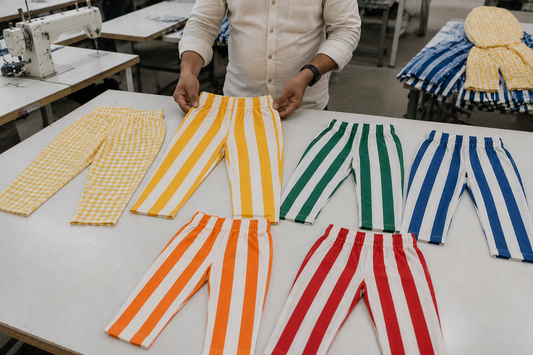
When we developed our cotton pants range, we made a conscious choice to build a collection that would be genuinely usable across genders and body types. The patterns we chose — gingham, stripes, checks, French Terry stripes — are all historically gender-neutral. The colours span blue, green, orange, lavender, melon, and olive: a palette that belongs to no specific gender.
The cut is relaxed and accommodates both the slightly wider hip typical in girls and the slightly squarer build typical in boys. The waistband is adjustable enough to work across the small variations in body proportion within a given size range.
The result is a collection that any child can wear, that can move freely within a family, and that gives parents maximum flexibility with minimum wardrobe complexity.
Browse the full unisex cotton pants collection for kids.
Frequently Asked Questions
Are Gozi cotton pants suitable for both boys and girls?
Yes. All our cotton pants are designed as unisex garments. The patterns, colours, and cuts are chosen to be wearable by and appropriate for all children.
Does unisex mean only neutral or muted colours?
No. Unisex means the design is not coded as specifically for one gender. Our range includes vibrant melon gingham, neon green stripes, rainbow multicolour, and other energetic colourways that are enthusiastically worn by children of all genders.
My daughter prefers “girly” styles. Will she like unisex pants?
Many children have strong style preferences by age 3 to 4. Our Melon Gingham, Lovebug, and Heartstrings Pants tend to be particularly popular with children who prefer warmer, more feminine palettes, while remaining technically unisex in construction and design.
Is there a price difference between our gendered and unisex pants?
No. All our cotton pants are priced at ₹699 for pure cotton styles. The unisex design is a design philosophy, not a product category with different pricing.
Tags:
Previous
Knee Pocket Cotton Pants for Kids: The Functional Design Choice Indian Toddlers Love
Next
Biowashing: What It Is and Why It Matters for Your Child's Cotton Pants