
Biowashing: What It Is and Why It Matters for Your Child's Cotton Pants
What Biowashing Actually Is
If you have spent any time looking at premium children's clothing in India, you have likely seen the word “biowashed” on product descriptions. It appears frequently on baby clothing, on premium cotton t-shirts, and on the better-quality kids' pants available in the market. It is used as a quality signal. But very few brands explain what it actually means or why it matters for your child.
We use biowashing in our cotton pants manufacturing. We want to explain, as clearly as we can, what the process involves and why it produces a genuinely better garment for children.
The Chemistry of Biowashing
Biowashing, also called enzyme washing or bio-finishing, is a fabric treatment process that uses biological enzymes — specifically cellulase enzymes — to modify the surface of cotton fabric.
Cellulase enzymes are naturally occurring biological molecules that break down cellulose — the plant-based polymer that cotton is made from. In biowashing, a controlled concentration of these enzymes is applied to cotton fabric in a water bath at a specific temperature. The enzymes act on the surface of the cotton fibres, breaking down and removing the short, protruding fibre ends — sometimes called “fuzz” or “pilling precursors” — that exist on the fabric surface after weaving or knitting.
The result is a fabric surface that is measurably smoother, softer, and more even than untreated cotton of the same yarn count and construction.
What Biowashing Does to Cotton Fabric for Children
Beyond the technical process, the practical effects of biowashing on a children's garment are meaningful across several dimensions.
Softness: The removal of surface fibre ends creates a smoother, softer hand feel. This is real softness from the fibre structure, not a surface treatment. It does not wash out. A biowashed cotton pant is softer after fifty washes than an untreated cotton pant of the same specification is on day one.
Reduced pilling: Pilling — the formation of small fibre balls on the fabric surface — is caused by the surface fibre ends wrapping around each other under friction and heat. By removing these fibre ends during biowashing, the likelihood of pilling is significantly reduced. This is particularly relevant for children's garments, which are worn in high-friction environments (sliding, crawling, vigorous movement).
Cleaner surface: Biowashing also removes residual processing chemicals that accumulate in cotton fabric during weaving and dyeing. These residuals are not necessarily dangerous, but their removal gives a cleaner, more hygienic fabric surface for skin contact — relevant for children, whose skin is more permeable than adult skin.
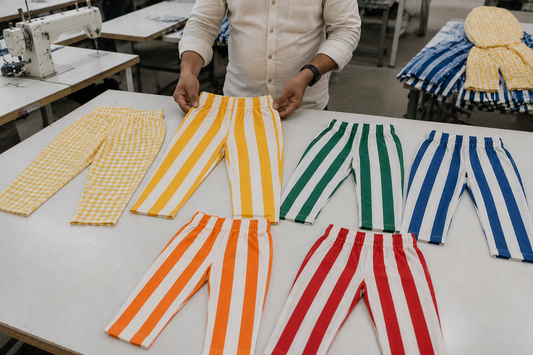
Colour clarity: By removing the surface fuzz from coloured cotton, biowashing makes colours appear crisper and more saturated. This is particularly visible in check and stripe patterns where the clarity of the pattern boundary depends on the fabric surface quality.
Biowashing vs Chemical Softening: The Critical Difference
We touched on chemical softening in our post about soft cotton labels. Biowashing and chemical softening are completely different processes that both produce soft fabric, but in fundamentally different ways.
Chemical softening applies a coating to the fabric surface. This coating creates a soft, smooth feel that lasts until the coating is washed away. After multiple wash cycles, the coating is gone and the underlying fabric — unchanged by the treatment — reveals its true hand feel.
Biowashing physically modifies the fibre structure. The surface fibre ends that are removed by the enzyme process are gone permanently. The fabric is genuinely and permanently softer, not temporarily coated to feel that way. No amount of washing restores the removed fibre ends.
This is why biowashed garments maintain their softness over many wash cycles while chemically softened garments do not. When we describe our cotton pants as biowashed, we mean that the softness you feel is structural and permanent, not a surface treatment that will wash out.
Why Biowashing Is Worth the Cost
Biowashing adds to the cost of manufacturing. The enzyme treatment requires additional processing time, water, controlled temperature conditions, and enzyme cost. These expenses are passed on in the product price.
For children's clothing specifically, we believe this cost is justified. Children wear their clothes for long periods every day. The garments go through the washing machine far more frequently than adult clothing. A fabric that maintains its softness, resists pilling, and retains colour clarity over many wash cycles delivers more value per rupee spent than a cheaper garment that deteriorates quickly, regardless of the initial price difference.
Find our biowashed cotton pants range at Gozi Cotton Pants for Kids.
Frequently Asked Questions
Are the enzymes used in biowashing safe for babies?
Yes. The enzyme wash is a manufacturing process. By the time the garment reaches the consumer, the enzyme treatment is complete and the fabric has been rinsed thoroughly. There is no enzyme activity remaining in the finished garment.
Can I tell by touch whether a garment has been biowashed?
Yes, in comparison. A biowashed cotton fabric feels distinctly smoother and softer than untreated cotton of the same specification. If you can handle both, the difference is immediately apparent. When buying online, look for brands that explicitly state biowashing in their product specifications.
Does biowashing affect the colour fastness of the fabric?
When done correctly, biowashing improves colour appearance rather than degrading it. An improperly controlled enzyme process can weaken fabric if the concentration is too high or the treatment time too long, but professional fabric processors manage these parameters carefully.
Is biowashing the same as preshrinking?
No. They are separate processes. Preshrinking applies mechanical or heat treatment to induce the shrinkage that would otherwise occur during the first consumer wash. Biowashing treats the fibre surface with enzymes for softness and pilling reduction. Good quality children's garments often undergo both processes.
Tags:
Previous
Why Unisex Cotton Pants Are the Smartest Buy for Indian Parents
Next
How Cotton Pants Help Prevent Heat Rash in Toddlers During Indian Summers