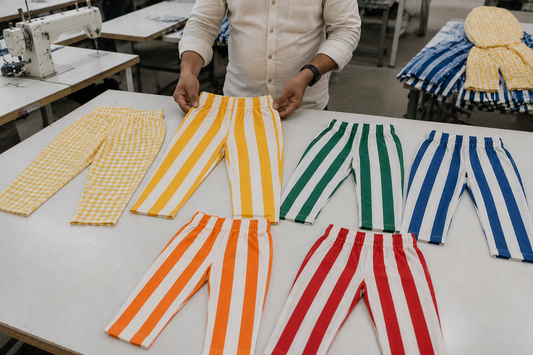
Sailor Stripes vs Plaid: Choosing Cotton Pants Patterns for Indian Kids
Two Pattern Families With Very Different Personalities
Sailor stripes and plaid are both classic patterns with long histories in children's clothing. They are both used in our cotton pants range, and they attract notably different buyers. Understanding the difference — not just visually but in terms of how they wear, what they pair with, and what occasions they suit — helps parents make better choices for their children's wardrobes.
In this post we compare sailor stripes and plaid cotton pants in practical terms, the way we would explain it to someone standing in front of both options trying to decide.
What Sailor Stripes Are and Why They Have Lasted
Sailor stripes — alternating bands of navy (or dark blue) and white — are one of the oldest patterns in children's clothing. They originated in naval dress uniforms in 19th century Europe and became associated with children's fashion through the maritime influence on seaside resort wear. The Breton stripe, as it is also known, has been in continuous production for over 150 years.
The longevity is not accidental. Navy and white is one of the most stable two-colour combinations in clothing. It works across seasons, across ages, across genders, and across a remarkable range of cultural contexts. It does not date because it has no particular moment — it is always correct in a way that fashion trends are not.
In practical terms, sailor stripe cotton pants are among the easiest bottoms to style. A white top pairs with the white in the stripe. A navy top pairs with the navy. Any number of other colours — yellow, coral, red, pale green — work as contrasts against the strong navy-white foundation. Very few tops clash with sailor stripes.
What Plaid Is and How It Differs
Plaid is a more complex pattern family. Unlike the parallel lines of a stripe, plaid involves crossing lines in both horizontal and vertical directions, creating a grid of squares and rectangles in multiple colours. The patterns in our check pants range — Rustwood Checks, the Heritage Checks, the Big Green Check — all fall within the broader plaid or tartan-derived check family.
Plaid has more visual complexity than stripe. The crossing lines create a busier surface that reads as more formal in small-scale patterns and more casual in large-scale patterns. The multi-colour nature of most plaid means there are more styling implications — more colours to either echo or contrast in the top selection.
In terms of heritage, plaid is associated with both formal Scottish tartans and casual flannel shirts, which means it carries a different kind of authority than sailor stripe. It can read as traditional, rustic, or smart-casual depending on the scale and colour combination.
Sailor Stripe vs Plaid: The Practical Comparison for Indian Parents
Versatility: Sailor stripe wins marginally. The two-colour navy-white combination has fewer styling constraints than the multi-colour plaid. Most tops pair easily with sailor stripes; plaid requires slightly more attention to colour compatibility.
Occasion range: Similar. Both are casual-to-smart-casual patterns. Neither is appropriate for formal occasions, and both are suitable for everything from daily wear to family gatherings.
Gender neutrality: Sailor stripe is highly gender-neutral. Plaid is also gender-neutral in principle, though specific colourways may read as more traditionally masculine (dark navy plaid, forest green plaid) or feminine (pink plaid, lavender plaid).
Age appropriateness: Both work across the 1–6 year range. Sailor stripe, being a simpler pattern, may suit younger toddlers slightly better where the visual simplicity complements a smaller figure. Plaid in a larger scale can look proportionally striking on older children.
Indian climate suitability: Both use lightweight woven cotton construction appropriate for Indian conditions. The fabric weight and breathability are comparable.
Which to Choose First
If you are buying one pattern for the first time, our recommendation is the Sailor Stripes — the navy-white combination is the more universally versatile and lower-maintenance styling choice. Add a check or plaid pant as the second purchase for variety.
If you already own a stripe pant and want to add something different, the Baby Blue Check or Rustwood Checks offer the visual contrast of a woven pattern while maintaining the pairing flexibility of a two-tone palette.
Browse both patterns in our cotton pants collection.
Frequently Asked Questions
Are sailor stripe pants appropriate for Indian festive occasions?
Yes, styled with a collared shirt or a cotton kurta. The navy-white combination is smart enough for most Indian family gatherings and festivals without looking informal.
Do plaid patterns fade evenly with washing?
Woven plaid uses yarn-dyed threads, so the colour is in the fibre structure. Even fading across the pattern is the norm rather than uneven surface print fading. Cold washing inside out maintains the pattern definition best.
Can sailor stripe and check pants be worn in the same week without the wardrobe feeling repetitive?
Yes. Despite both being classic patterns, sailor stripe and check are visually distinct enough to not read as repetitive in a weekly rotation. Different top colours further differentiate the daily outfits.
Which is more popular in the Gozi range, sailor stripes or check patterns?
Our check pants, specifically the Baby Blue Check, have our highest inventory and consistent repeat orders. Our Sailor Stripes are our most popular stripe style. Both are among our better-performing styles across all sizes.
Tags:
Previous
Rainbow Striped Cotton Pants for Kids: Why Bright Colours Work for Indian Children
Next
How to Buy Cotton Pants for Kids as a Gift in India: A Practical Guide