How to Mix and Match Cotton Pants for Kids to Create More Outfits with Fewer Pieces
A Question About Pattern Mixing
One of the most common styling questions we hear from Indian parents is: I have three pairs of your cotton pants in different patterns — check, stripe, and gingham. How do I get the most outfit combinations out of them without buying too many tops?
It is a practical question that deserves a practical answer. Pattern mixing in kids' clothing is simultaneously simpler than most parents assume and more systematic than just grabbing whatever is clean. Here is the framework we use, and the approach that generates the most outfit combinations from the fewest pieces.
The One-Pattern Rule
The fundamental rule in styling patterned pants is: one pattern at a time. If the pants have a pattern — check, stripe, or gingham — the top should be a solid colour. This is not a rigid stylistic law, but it is the most reliable starting point and the one that works consistently across the age range of children who wear our pants.
The reason is visual hierarchy. When two patterns are present in the same outfit, the eye tries to reconcile them. If the patterns are different in scale (a small gingham pant with a large floral print top, for example), the combination can work. But in practice, mixing patterns in children's clothing requires careful scale and colour coordination that takes more mental effort than most parents want to invest at 7 in the morning.
Solid-colour tops paired with patterned pants work immediately, always, and with zero styling deliberation. This is the system that makes a small wardrobe feel like a large one.
The Colour Anchor: Pulling One Colour from the Pattern
The simplest and most effective top-selection strategy for check and gingham pants is to pull one colour from the pattern and repeat it in the top.
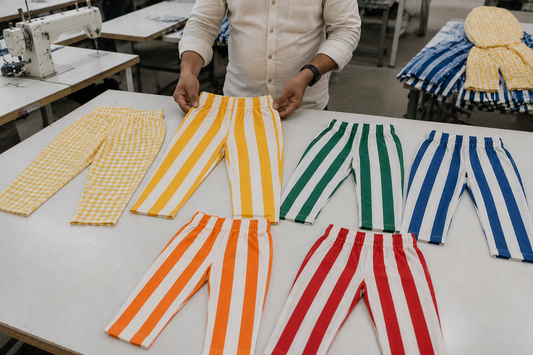
For Baby Blue Check: a solid blue top, or a solid white top. Both are immediately coherent because one repeats a colour from the pattern and the other pairs with its neutral partner.
For Melon Gingham: a coral or soft red top echoes the warm tones. A white top creates clean contrast. Both work immediately.
For Sailor Stripes: navy echoes the stripe. White provides the contrast. Both are correct.
For the multicolour Rainbow Rush pants: white is the answer. It gives every colour in the pant a clean background to read against. Any other solid creates a competition with one of the many rainbow colours.
For Dark Green French Terry: white, off-white, or olive are the strongest pairings. A mustard or terracotta top also works beautifully with the green stripe.
Building a Pairing Matrix
If you have three pairs of our cotton pants — Baby Blue Check, Sailor Stripes, and one French Terry stripe — here is the top collection that gives you the most outfit combinations:
White (pairs with all three), Navy (pairs with Baby Blue Check and Sailor Stripes), Coral or orange (pairs with Baby Blue Check and French Terry), Yellow (pairs with Baby Blue Check and French Terry), Lavender (pairs with Baby Blue Check and Sailor Stripes).
Five solid-colour tops, three pairs of pants: fifteen outfit combinations. Add a sixth top and the combinations expand further. This is how a minimal wardrobe creates meaningful variety.
Seasonal Colour Adjustments for the Indian Context
Indian light and Indian seasons affect colour perception in clothing. In peak summer, bright, high-contrast pairings — white top with bold gingham, yellow top with navy stripe — look fresh and appropriate. In the cooler winter months, slightly muted pairings — olive top with dark green French Terry, mustard top with sand stripes — have more seasonal resonance.
This seasonal shift does not require buying different pants. The same pairs of cotton pants with different top selections carry across Indian seasons naturally. The patterns are neutral; the top colour provides the seasonal personality.
Build your mix-and-match wardrobe around our cotton pants collection for kids.
Frequently Asked Questions
Can striped pants be worn with a top that has a small print?
Yes, if the print is small-scale (microprint, tiny dots, subtle texture) and shares at least one colour with the stripe. Small-scale patterns create texture rather than competing visual patterns. Large-scale prints with stripes are harder to manage without careful colour coordination.
What colours to avoid with check pants?
Avoid tops in clashing pattern families — large florals, bold geometric prints, heavy graphics — with check pants. In terms of colour, almost any solid works with most checks. The main colour to use with caution is a strong clash against both colours in the check: a bright green top with a red-and-white gingham, for example, creates three competing colours without a unifying element.
Is it possible to wear patterned tops with our pants?
Yes, with the scale rule: the top pattern should be smaller in scale than the pant pattern, or vice versa, not similar scale. A fine-stripe top with a large-check pant works because the scales differ. A large-stripe top with a large-stripe pant is too much repetition at the same scale.
How many pairs of cotton pants should I have for easy mixing and matching?
Three pairs with different patterns gives enough variety. Beyond four to five pairs, the additional variety starts to require more top variety to maximise, at which point the minimal wardrobe benefit diminishes.
Tags:
Previous
Elastic Waist Cotton Pants for Kids: Why Waistband Construction Matters More Than You Think
Next
Cotton Pants for Kids Aged 6–12 Months: What Matters Most for Indian Babies