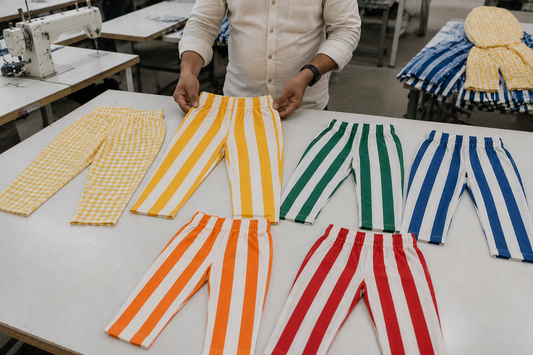

Why 30s Combed Cotton Is the Best Fabric for Kids' Pants in India
Why the Number on the Yarn Tag Changes Everything
When parents ask us what makes our cotton pants softer than what they have tried before, the answer almost always comes down to yarn count. It is a technical detail that never appears on a product label, rarely gets mentioned in brand marketing, and yet is probably the single most important factor determining how a cotton garment feels against your child's skin.
As cotton manufacturers, we want to demystify this. Here is what yarn count means, why it matters for children's clothing specifically, and why 30s combed cotton is the specification we chose for our kids' pants range.
What Is Yarn Count?
Yarn count, in the cotton textile system used in India, refers to the number of 840-yard lengths of yarn that weigh one pound. A 30s count yarn means that 30 lengths of 840 yards weigh one pound. A 20s count yarn means that only 20 such lengths weigh one pound.
In simple terms: the higher the count number, the finer and thinner the individual thread. A 30s yarn is finer than a 20s yarn. A 40s yarn is finer still.
Finer thread means more threads can be packed into the same area of fabric. More threads per area means a denser, smoother, softer surface. This is why high yarn count fabrics feel silkier and more refined than low count fabrics.
For children's clothing, this translates directly into the question of whether a garment feels pleasant against sensitive skin or whether it feels rough and irritating.
Combed Cotton: The Extra Step That Matters
Beyond count, there is another specification that significantly affects fabric quality: whether the cotton was combed before spinning.
Raw cotton fibre contains short, irregular fibres mixed in with the long, smooth fibres that give cotton its best properties. In standard cotton processing, all of these fibres are spun together. The resulting yarn has a slightly irregular, somewhat rough character.
In combed cotton processing, the raw fibre is passed through fine combs that remove the short, irregular fibres and align the long fibres in parallel before spinning. The resulting yarn is smoother, stronger, more uniform, and significantly softer than standard cotton yarn of the same count.
The difference between 30s standard cotton and 30s combed cotton is substantial. Both have the same count number, but the combed version produces a fabric that feels measurably softer and more refined. It also pills less over time, holds its colour better, and maintains its smoothness through repeated washing.
All of our cotton pants use combed cotton. The cost difference versus standard cotton is real, but for children's clothing that sits against skin all day, we consider it non-negotiable.
Why 30s Is the Right Count for Kids' Cotton Pants in India
Lower count fabrics — 20s and below — produce heavier, coarser fabric. These work well for workwear, denim-weight garments, and items where durability under rough use is the priority. For children's everyday pants in Indian summer conditions, they are too heavy and too rough.
Higher count fabrics — 40s, 50s, and above — produce finer, lighter fabrics that feel beautiful but sacrifice some durability. A 40s cotton shirt is exquisite. A 40s cotton pant for an active toddler who rolls in dirt and goes through the washing machine four times a week will wear out faster than it should.
30s combed cotton sits in the right place for toddler pants. It is soft enough to be comfortable against the sensitive skin of a 1 to 6 year old. It is substantial enough to survive the mechanical stress of frequent Indian laundry conditions. It holds its shape through the elasticated waist construction without distorting. And it maintains its colour through repeated cold washing far better than lower count alternatives.
How to Tell If a Brand Is Using Quality Yarn
Brands rarely disclose yarn count on product pages. Here is how you can assess quality from what you can observe.
Feel the surface. High count combed cotton has a smooth, almost silky hand feel when dry. It should not feel rough, grabby, or fibrous. If a fabric has a slightly fluffy or fuzzy surface before the first wash, it is likely a lower count or non-combed cotton.
Look at the fabric in strong light. High count fabric is dense and even. Lower count fabric shows irregular weave structure and more visible individual threads.
Wash it and check what happens. Low count cotton pills noticeably within the first five washes. The surface develops small fibre balls, particularly in areas of friction. High count combed cotton does not pill this way. This is probably the most reliable test, and the reason we are confident in our products — our customers report back on wear over months, not just the first few days.
Shop our cotton pants for kids, all made from 30s combed cotton.
Frequently Asked Questions
What yarn count do most cheap kids' pants in India use?
Most budget-priced kids' clothing uses 20s or 24s standard (non-combed) cotton. It is functional but noticeably rougher and less durable than higher count combed alternatives.
Is 40s cotton better than 30s for toddler pants?
Softer, yes. But also less durable under frequent washing and heavy use. For toddler pants specifically, 30s combed cotton is the better practical choice.
Does yarn count affect colour vibrancy?
Yes. Higher count combed cotton accepts dye more evenly, resulting in richer, more consistent colour. This is particularly visible in gingham and check patterns, where colour consistency across the weave affects the sharpness of the pattern.
How many washes should quality 30s combed cotton pants last?
With proper cold washing and line drying, a well-made 30s combed cotton pant should maintain its softness and colour through 80 to 100 wash cycles. That is typically more than enough for a child to outgrow the size.
Tags:
Previous
How to Wash Cotton Kids' Pants in India: Hard Water, Colours, and Machine Wash Tips
Next
Striped Cotton Pants for Kids: A Style That Works from Playdate to Family Gathering