
Why Undyed Cotton Pants Are Safer for Babies in Indian Summers
What We Saw in the Market That Troubled Us
We have been sourcing and manufacturing cotton fabric for children's clothing in India for a long time. We visit mills, we read lab reports, we speak to dye houses. And one thing became increasingly clear to us as we developed our cotton pants range: the Indian kids' clothing market has a dye problem that nobody is talking about openly.
Bright colours sell. Vivid prints attract attention. And to achieve those colours at the price points Indian consumers expect, many manufacturers use dye formulations that cut corners on safety. This post is not about scaring you. It is about giving you the information to make a better choice for your child.
What Are AZO Dyes and Why Do They Matter?
AZO dyes are a large class of synthetic dyes used widely in textile manufacturing. They are cheap, they produce vivid colours, and they bond well to cotton fibres. They are also used extensively in Indian textile production because they are affordable and effective.
The problem is that certain AZO dyes, when they break down — from sweat, heat, body friction — release aromatic amines. Some of these aromatic amines are classified as carcinogens. The European Union banned the use of certain AZO dyes in textiles that come into prolonged skin contact back in 2003. Many global brands now require their supply chains to be AZO-free.
Indian standards are catching up, but enforcement in the unorganised kids' clothing sector remains inconsistent. When you buy a brightly coloured pair of children's pants from an unknown manufacturer at a low price, you genuinely do not know what dyes were used.
What Happens to Dye When a Baby Wears Cotton in Indian Summer Heat
This is where the Indian context specifically matters. In peak summer, a toddler wearing cotton pants in a city like Chandigarh, Delhi, or Mumbai sweats. A lot. Sweat is mildly acidic. Moisture and heat together create conditions where dye molecules become mobile — they can transfer from fabric to skin more readily than in cool, dry conditions.
Toddlers also put everything in their mouths. Pants fabric gets chewed on, sucked on, gripped with wet hands. The oral contact point is another avenue for dye transfer that parents rarely think about.
We are not suggesting that every coloured kids' pant in India is dangerous. We are saying that the risk is real enough that when we had a choice, we chose the safer option for our customers' children.
The Decision We Made: Undyed Inner Layer
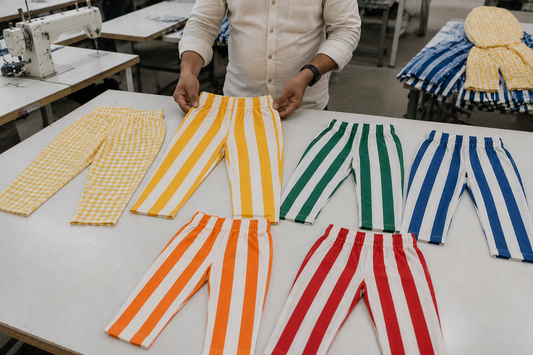
When we designed our French Terry cotton pants range, we separated the fabric into two surfaces: the outside and the inside. The outside — the stripe you see, the colour that makes the pant look beautiful — uses dyes that sit on the outer face of the fabric. The inside, the looped cotton layer that rests directly against your child's skin all day, is completely undyed.
We call this the undyed natural cotton base. It is not bleached. It is not treated. It is raw, natural cotton in its unprocessed colour — an off-white, cream tone that reflects the natural colour of the cotton fibre itself.
This means that even if the outer dye molecules were to migrate under extreme sweat conditions, they would need to pass through the entire fabric structure before reaching skin. In practice, that does not happen. But more importantly, the surface your baby actually feels all day has never been touched by a dye formulation of any kind.
How to Identify Safe Cotton Pants in the Indian Market
Most brands will not voluntarily disclose their dye formulations. Here is what you can look for when shopping for cotton pants for your toddler in India.
Look for OEKO-TEX or GOTS certification: These international standards require testing for harmful substances including banned AZO dyes. If a brand carries these certifications on children's products, it has passed independent testing.
Ask about fabric construction: Does the garment have a separate inner and outer layer? If a brand has specifically addressed skin-side fabric treatment, that is a strong signal they are thinking about safety seriously.
Check wash fastness: A simple home test: wash a new brightly coloured garment with a white cloth. If significant colour transfers to the white cloth, the dye is poorly fixed. Well-fixed dyes stay on the fabric, not on the skin.
Buy from manufacturers, not just traders: Brands that make their own fabric have direct control over their dye inputs. Traders who source from multiple manufacturers may not know — or may not ask — what dye formulations were used.
What Undyed Cotton Feels Like
We get asked this often. Parents sometimes assume undyed means scratchy, unfinished, or rough. It is the opposite. The natural cotton base in our French Terry pants is the softest surface in the garment. Cotton in its natural state, without chemical processing, has a gentleness that treated cotton sometimes loses.
It also does not fade. There is no colour to lose. The natural off-white tone of the inner layer stays exactly the same wash after wash, year after year. If you ever see the inside of a Gozi French Terry pant after fifty washes, it looks exactly as it did on day one.
Explore our full cotton pants collection and see which styles are right for your child.
Frequently Asked Questions
Are all Gozi cotton pants undyed on the inside?
Our French Terry collection features the undyed natural cotton base on the inner layer. This is the collection we specifically developed with skin-contact safety as the primary design criterion.
Are AZO dyes currently banned in India for children's clothing?
India has regulations governing AZO dyes in textiles, but enforcement across the entire market, especially the unorganised sector, is inconsistent. Buying from certified or transparent manufacturers is the safest approach.
Does undyed cotton mean the pants have no colour at all?
No. The outside of the pants has beautiful stripe colours. Only the inner face, which touches your child's skin, is left in its natural undyed state.
Is undyed cotton suitable for babies with eczema or skin allergies?
Yes. The absence of dye chemicals makes natural cotton one of the safest fabrics for children with skin sensitivities. We recommend consulting a paediatrician for specific skin conditions.
Tags:
Previous
What Is French Terry Fabric and Why Indian Moms Are Choosing It for Their Toddlers' Cotton Pants
Next
Cotton vs Polyester Pants for Kids in Indian Summer — A Cotton vs Polyester Pants for Kids in Indian Summer — A Manufacturer Explains