
What Is French Terry Fabric and Why Indian Moms Are Choosing It for Their Toddlers' Cotton Pants
The Question We Hear Every Week at Gozi
We have been making cotton clothing for children in India for years. We know our yarn counts, our fabric weights, our wash cycles. And every single week, a new batch of moms discovers our French Terry pants and asks the same question: What exactly is French Terry?
It is a fair question. The name sounds foreign, maybe even fussy. But the fabric itself is one of the most practical things you can put on an Indian child. In this post, we will explain what French Terry is, how it is made, why we chose it for our cotton pants range, and why so many Indian moms have made it their go-to fabric for toddler bottoms.
What Is French Terry Fabric?
French Terry is a knit cotton fabric. It has a smooth, flat surface on the outside and soft, looped threads on the inside. Think of it as the comfortable, breathable cousin of a regular sweatshirt fabric — but lighter and far better suited to the Indian climate.
The key difference from a standard jersey cotton is that French Terry has those interior loops. Those loops trap air. Trapped air means your child stays cooler when it is hot and warmer when there is a chill. It is a self-regulating fabric, which in a country where mornings can be cool and afternoons brutal, is genuinely useful.
French Terry is also heavier and more structured than jersey cotton. This means the pants hold their shape better, survive more washes, and do not go limp and thin after six months of regular use — a complaint we hear constantly about cheaper kids' bottoms available on the market.
Why We Use an Undyed Cotton Base for Our French Terry Pants
This is the part that separates our French Terry collection from everything else in the market. When we developed these pants, we made a deliberate decision: the inner layer — the looped side that sits directly against your child's skin — would be left undyed. Natural. Untreated.
Why does this matter? Because conventional fabric dyeing uses a range of chemicals, including in many cases AZO dyes, which are a class of synthetic dyes known to break down on skin contact and release compounds that are not safe for young children. Indian regulatory standards on children's clothing dyes are improving but they are not yet where European standards are. In the absence of guaranteed safety, we chose the simplest solution: no dye on the skin side.
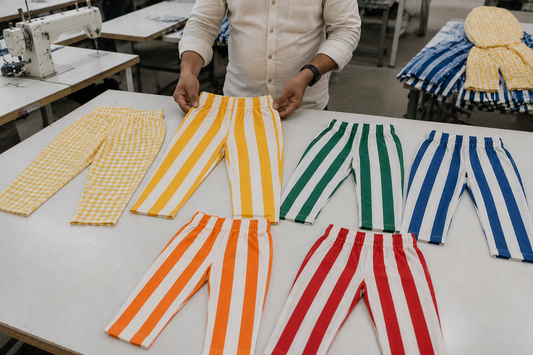
What you see on the outside of our French Terry pants — the green stripe, the orange stripe, the black and white stripe — that colour sits on the outer face of the fabric. The inner base, the part your toddler actually feels, is undyed, natural cotton. We think that is the right way to make clothes for children.
How French Terry Performs in Indian Conditions
India is not a single climate. Chandigarh in May is different from Kochi in December is different from Shimla in January. We design our French Terry pants to perform across these conditions.
In hot weather, the fabric breathes well because of its open-loop construction. Sweat wicks away rather than sitting on the skin. This is particularly important for toddlers, who generate a surprising amount of body heat when they are running, climbing, and generally refusing to sit still. Synthetic fabrics trap heat. Tightly woven cotton can feel stiff and scratchy when wet. French Terry does neither.
In cooler weather or air-conditioned spaces — and most Indian households run the AC hard from April through September — the looped interior provides light insulation without bulk. Your child does not need to be bundled into thick clothes. These pants provide just enough warmth without making movement difficult.
We have also designed our French Terry pants with a knee-level pocket on one side. Kids put things in pockets. Rocks, leaves, bits of biscuit, small toys. The pocket is deep enough to be useful and placed so it does not affect the fit or the waistband.
What to Look for When Buying French Terry Pants for Your Toddler
Not all French Terry is the same. Here is what we look for, and what you should too.
Yarn count: We use 30s yarn. Higher yarn count means finer, softer thread. Cheaper French Terry garments are often made with 20s yarn, which feels coarser and pills faster.
GSM: Our French Terry sits in the 220–260 GSM range. Too light and the pants lose structure. Too heavy and they become unsuitable for Indian summers. This range works year-round.
Waistband construction: Look for a wide, soft elasticated waistband. Thin, tight waistbands leave marks on toddler skin. Ours are designed to sit comfortably without pinching, which matters when a child wears the same pair for eight hours.
Undyed inner layer: Ask specifically about this. Most brands do not offer it. We consider it non-negotiable for children's clothing.
How to Wash French Terry Cotton Pants
French Terry is easy to care for. Wash in cold or lukewarm water, inside out, to protect the outer colour. Do not use harsh detergents or bleach. Line dry in shade — direct sunlight can fade the stripe colours over time. In areas with hard water, which covers most of North India, we recommend a mild fabric conditioner in every wash. Hard water can make cotton feel stiff over time. A small amount of conditioner keeps French Terry feeling as soft as the day you bought it.
Browse our full range of cotton pants for kids and find the right pair for your child.
Frequently Asked Questions
Is French Terry good for Indian summers?
Yes. Its looped construction allows air circulation and moisture wicking, making it more comfortable than jersey or woven cotton in hot and humid conditions.
Is the inner layer of Gozi French Terry pants safe for babies with sensitive skin?
Yes. We leave the inner cotton base completely undyed. No dyes or harsh chemicals come in contact with your child's skin.
How is French Terry different from sweatshirt fabric?
Both have looped interiors, but French Terry is lighter and more breathable. Sweatshirt fabric is heavier and better suited to cold weather. French Terry works year-round in India.
What yarn count should I look for in French Terry pants for kids?
30s yarn or higher. It produces a finer, softer fabric that lasts well and does not pill after repeated washing.
Tags:
Previous
Cotton Clothes for Toddlers in Indian Summer: What Every Mom Needs to Know
Next
Why Undyed Cotton Pants Are Safer for Babies in Indian Summers