
Size Chart for Kids by Age and Height (1 to 8 Years), and How to Measure at Home
Short answer: buy kids clothes by height first and age second. A typical child is about 76 cm tall at 1 year, 87 cm at 2, 96 cm at 3, 103 cm at 4, 110 cm at 5, 116 cm at 6, 122 cm at 7 and 127 cm at 8 (WHO medians for boys; girls are about 1 cm shorter). So a "2-3Y" label is really built for a child of roughly 87 to 96 cm. Below is that size chart for kids by age and height, the real garment measurements of our cotton co-ord sets for kids, and a two minute method to measure at home.
We make children's clothes in our own unit in Tiruppur, and this guide is our full answer to the question every parent shopping online runs into: "My child is 3 but tall, so which size?" Every number in it comes either from a published growth standard (WHO, Indian Pediatrics) or from our own size charts, and we show you which is which.
Shop this guide


In this guide
- What is the right size for my child's age and height?
- What do the measurements on a kids size chart actually mean?
- Gozi size chart: real garment measurements in inches and cm
- How do I measure my child for clothes at home?
- What if my child is between two sizes?
- Should I buy one size bigger?
- Does sizing change for T-shirts, pants, kurtas and night suits?
- 60 second size checklist before you order
- FAQ
What is the right size for my child's age and height?
An age label on kidswear is a shortcut for a height band. Two children of the same age can be 10 cm apart, and that gap is more than one full size. That is why every reliable size chart starts with height.
The table below uses the World Health Organization's growth medians: the WHO Child Growth Standards for ages up to 5, and the WHO Growth Reference for 5 to 19 years for ages 6 to 8. The median is the middle child: half of children are taller, half are shorter. Waist figures are the 50th percentile body waist from a study of 9,060 children in Bengaluru published in Indian Pediatrics (Kuriyan et al., 2011), which is the closest Indian data for this age group.
| Size label | Typical age | Boys height (WHO median) | Girls height (WHO median) | Body waist, 50th percentile (Indian children) |
|---|---|---|---|---|
| 1-2Y | 12 to 24 months | 75.7 to 87.1 cm (29.8 to 34.3 in) | 74.0 to 85.7 cm (29.1 to 33.7 in) | Not covered by the study (it starts at 3 years) |
| 2-3Y | 2 to 3 years | 87.1 to 96.1 cm (34.3 to 37.8 in) | 85.7 to 95.1 cm (33.7 to 37.4 in) | Boys 48.4 cm, girls 49.3 cm at 3 years (about 19 in) |
| 3-4Y | 3 to 4 years | 96.1 to 103.3 cm (37.8 to 40.7 in) | 95.1 to 102.7 cm (37.4 to 40.4 in) | Boys 49.9 cm, girls 50.2 cm at 4 years (about 19.7 in) |
| 4-5Y | 4 to 5 years | 103.3 to 110.0 cm (40.7 to 43.3 in) | 102.7 to 109.4 cm (40.4 to 43.1 in) | Boys 51.5 cm, girls 51.4 cm at 5 years (about 20.2 in) |
| 5-6Y | 5 to 6 years | 110.0 to 116.0 cm (43.3 to 45.7 in) | 109.4 to 115.1 cm (43.1 to 45.3 in) | Boys 53.1 cm, girls 52.9 cm at 6 years (about 20.9 in) |
| 6-7Y | 6 to 7 years | 116.0 to 121.7 cm (45.7 to 47.9 in) | 115.1 to 120.8 cm (45.3 to 47.6 in) | Boys 54.8 cm, girls 54.8 cm at 7 years (about 21.6 in) |
| 7-8Y | 7 to 8 years | 121.7 to 127.3 cm (47.9 to 50.1 in) | 120.8 to 126.6 cm (47.6 to 49.8 in) | Boys 56.6 cm, girls 56.8 cm at 8 years (about 22.3 in) |
How to read it: find your child's height in the boys or girls column and use that row's size label, even if it does not match their age. A 3 year old who is 99 cm tall fits the 3-4Y row, and that is the size to buy.
Are Indian children shorter than the WHO chart? Slightly, at school age. The Indian Academy of Pediatrics growth charts for Indian children (Khadilkar et al., Indian Pediatrics 2015) put the median 6 year old boy at 114.8 cm and the median 8 year old boy at 126.4 cm, about 1 cm below WHO. For buying clothes that difference is too small to change the size, so the WHO table works well for Indian children.
What do the measurements on a kids size chart actually mean?
This is where most size chart pages lose parents. There are two completely different kinds of numbers on kidswear charts, and they are not interchangeable:
- Body measurements describe the child: height, chest around the body, waist around the body. The WHO and Indian Pediatrics figures above are body measurements.
- Garment measurements describe the clothing itself, measured on a table. A garment is always bigger than the body it fits, because a child needs room to breathe, run and sit on the floor. That extra room is called ease.
Most Indian brand charts, including ours, are garment measurements, and most of them are taken with the piece laid flat. A flat chest measurement is the width across the front, armpit to armpit, which is half the full circumference. That is why our 1-2Y T-shirt shows a chest of 12 inches: laid flat it is 12 inches across, so the full chest all the way round is about 24 inches (61 cm), comfortably more than a one year old's body.
The same logic applies to elastic waists. A flat waist of 7.5 inches is the relaxed elastic measured edge to edge. Double it and the relaxed waist is about 15 inches; the elastic then stretches to sit gently around a toddler's waist and over a nappy.
| Term on the chart | What it means | Where it is measured | Body or garment? |
|---|---|---|---|
| Height | How tall the child is, without shoes | Floor to the top of the head | Body |
| Chest (on a T-shirt or shirt) | Width of the garment across the front | Armpit seam to armpit seam, laid flat (double for full chest) | Garment |
| Length (T-shirt) | How far the top comes down | Highest point of the shoulder, next to the collar, straight down to the hem | Garment |
| Back length (shirt) | Length of a collared shirt | Centre of the collar seam at the back, straight down to the hem | Garment |
| Waist (shorts or pants) | Width of the waistband | Top edge of the waistband, relaxed, edge to edge (double for full waist) | Garment |
| Length (shorts or pants) | How long the bottom is | Top of the waistband at the side, straight down to the hem | Garment |
| Waist (body) | Around the child's tummy | Midway between the lowest rib and the hip bone, tape snug, child breathing out | Body |
Once you know which kind of number you are looking at, size charts stop being confusing. If a chart does not say whether it is body or garment, a quick test: if the 1-2Y chest is under 15 inches (38 cm), it is a flat garment measurement, because no toddler has a chest that small.
Gozi size chart: real garment measurements in inches and cm
These are the size charts we publish on our product pages, converted to centimetres so you can compare them with any tape. All are garment measurements in inches, taken flat. We make every piece in pure cotton in Tiruppur, and the printed T-shirt sets are pre-shrunk, so the size that fits on day one should keep fitting after washing.
Printed cotton T-shirt and shorts co-ord sets
| Size | T-shirt chest (flat) | T-shirt length | Shorts waist (flat, relaxed) | Shorts length |
|---|---|---|---|---|
| 1-2Y | 12 in (30.5 cm) | 14 in (35.6 cm) | 7.5 in (19.1 cm) | 9 in (22.9 cm) |
| 2-3Y | 12.5 in (31.8 cm) | 14.5 in (36.8 cm) | 8 in (20.3 cm) | 10 in (25.4 cm) |
| 3-4Y | 13 in (33.0 cm) | 15.5 in (39.4 cm) | 8.5 in (21.6 cm) | 11 in (27.9 cm) |
| 4-5Y | 14 in (35.6 cm) | 16 in (40.6 cm) | 9 in (22.9 cm) | 11.5 in (29.2 cm) |
| 5-6Y | 14.5 in (36.8 cm) | 17 in (43.2 cm) | 9.5 in (24.1 cm) | 12 in (30.5 cm) |

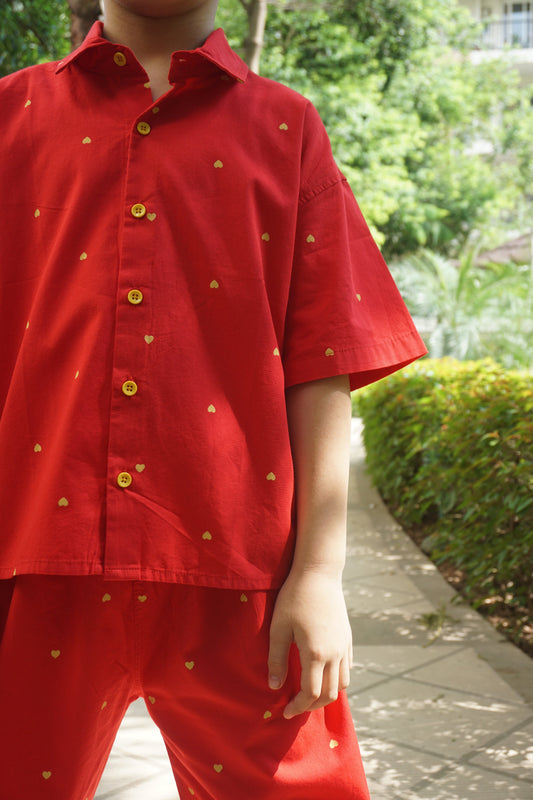
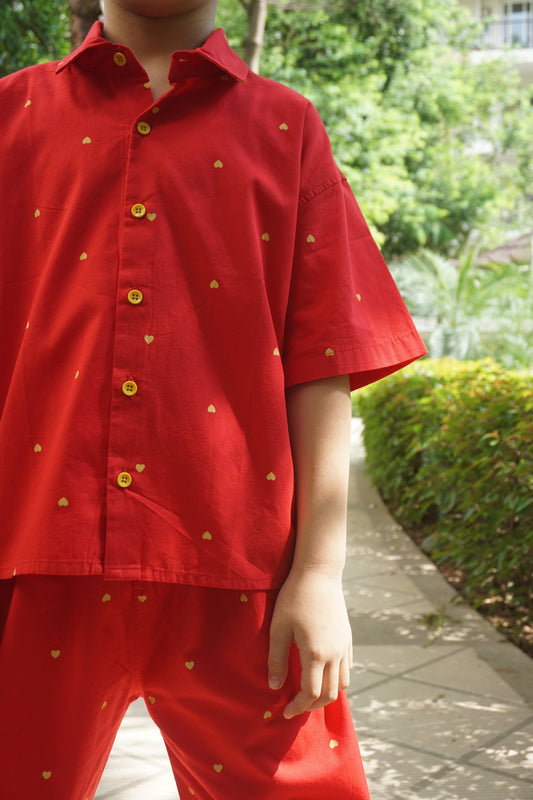
Cotton seersucker shirt and shorts co-ord sets (Picnic Checks)
| Size | Shirt chest (flat) | Shirt back length | Shorts waist (flat, relaxed) | Shorts length |
|---|---|---|---|---|
| 1-2Y | 13 in (33.0 cm) | 15 in (38.1 cm) | 7.5 in (19.1 cm) | 9 in (22.9 cm) |
| 2-3Y | 13.5 in (34.3 cm) | 16 in (40.6 cm) | 8 in (20.3 cm) | 9.5 in (24.1 cm) |
| 3-4Y | 14 in (35.6 cm) | 16.75 in (42.5 cm) | 8.5 in (21.6 cm) | 10 in (25.4 cm) |
| 4-5Y | 14.5 in (36.8 cm) | 17.5 in (44.5 cm) | 9 in (22.9 cm) | 11 in (27.9 cm) |
| 5-6Y | 15 in (38.1 cm) | 18.5 in (47.0 cm) | 9.5 in (24.1 cm) | 11.5 in (29.2 cm) |
| 6-7Y | 16.5 in (41.9 cm) | 19.25 in (48.9 cm) | 10 in (25.4 cm) | 12.5 in (31.8 cm) |
| 7-8Y | 17 in (43.2 cm) | 20 in (50.8 cm) | 10.25 in (26.0 cm) | 13 in (33.0 cm) |
Notice that the seersucker shirt is about 1 inch wider and 1 inch longer than the printed T-shirt in the same size. That is deliberate. A woven shirt does not stretch the way a knitted T-shirt does, so it needs more room to move in. This is the single most useful thing a size chart can teach you: the same age label can mean different measurements in different fabrics, and that is correct, not a mistake.

French terry cotton pants
| Size | Pant length | Waist (flat, relaxed) |
|---|---|---|
| 1-2Y | 18 in (45.7 cm) | 7.5 in (19.1 cm) |
| 2-3Y | 19.5 in (49.5 cm) | 8 in (20.3 cm) |
| 3-4Y | 23 in (58.4 cm) | 8.5 in (21.6 cm) |
| 4-5Y | 24.5 in (62.2 cm) | 9 in (22.9 cm) |
| 5-6Y | 27 in (68.6 cm) | 9.5 in (24.1 cm) |
| 6-7Y | 28.5 in (72.4 cm) | 10 in (25.4 cm) |
| 7-8Y | 30 in (76.2 cm) | 10.5 in (26.7 cm) |
The jump in pant length between 2-3Y and 3-4Y (19.5 to 23 inches) is the biggest step in the chart, so if your child is at the top of the 2-3Y height band, full-length pants are where you will feel the pinch first.

Full size guide, 1 to 8 years
The Picnic Checks Co-ord Set for Kids, Blue
100% export-grade cotton seersucker with woven checks, OEKO-TEX Standard 100 certified, relaxed-fit Chinese collar shirt with matching shorts.
₹1,399See sizes and colours →
How do I measure my child for clothes at home?
You need a soft measuring tape (a tailor's tape), a wall, a flat book and one T-shirt and one pair of shorts or pants that fit your child well today. It takes about two minutes.
Step 1: Height (the number that matters most)
- Take off shoes, hair clips and buns.
- Stand your child with heels, bottom and shoulders against a wall, feet together, looking straight ahead.
- Rest a flat book on the top of the head, at a right angle to the wall, and mark the wall under it with a pencil.
- Measure from the floor to the mark. Measure twice; if the two readings differ, take a third and use the middle one.
For a child under 2 who will not stand still, lay them on a bed or the floor with the head against a headboard or wall and measure to the heel with the leg gently straightened. Doctors measure lying length below 2 years for exactly this reason, which is why the WHO tables switch from length to height at 24 months.
Step 2: Measure a garment that already fits (the parent's shortcut)
This is more reliable than measuring a wriggling child, and it matches how brand charts are written.
- Lay their best-fitting T-shirt flat on a bed, front facing up, smoothed but not stretched.
- Measure straight across from one armpit seam to the other. That is the flat chest. Compare it with the chest column in the chart.
- Measure from the highest point of the shoulder, beside the collar, straight down to the hem. That is the length.
- Lay the shorts or pants flat and measure the waistband edge to edge without stretching it, then from the top of the waistband at the side down to the hem.
Pick the size whose numbers are equal to, or up to about half an inch (1 cm) bigger than, the garment that fits. If the current favourite is already short in the body but fine across the chest, follow the length: children grow taller faster than they grow wider.
Step 3: Body waist (only if the child is very slim or very sturdy)
Wrap the tape around the tummy midway between the lowest rib and the top of the hip bone, snug but not tight, while your child breathes out normally. This is the same method used in the Indian Pediatrics study. If the result is well above the waist figure for their height row in the first table, size up for bottoms with an elastic waist; if it is well below, stay in the height size and use the drawcord, if there is one.

What if my child is between two sizes?
Use this decision guide. It covers the common "between sizes" cases.
| Your situation | Choose | Why |
|---|---|---|
| Height is in the upper third of the band (for example 94 cm in 2-3Y) | The next size up | They will reach the next band within a few months; a slightly long T-shirt is fine, a short one is not |
| Height is in the lower third of the band | The size that matches their height | The fit will be right now and still right in six months |
| Still in nappies (1 to 2 years) | Size up for shorts and pants | A nappy adds bulk at the seat and waist, not at the chest |
| Slim build, average height | Height size, tighten the drawcord if there is one | An elastic waist adjusts; a T-shirt that is too wide just looks big |
| Sturdy build, average height | Size up | Chest and waist matter more than length for comfort |
| Buying a woven shirt (seersucker, poplin) rather than a knit T-shirt | Height size, but check the chest | Woven fabric does not stretch; the chest must have room |
| Buying for a gift and you do not know the height | One size above their age | A slightly big outfit gets worn later; a small one never gets worn |
Should I buy one size bigger?
Only some of the time, and the answer depends on age. The WHO medians show how fast a typical child grows each year:
| Age | Typical growth that year (boys, WHO median) | What it means for buying |
|---|---|---|
| 1 to 2 years | About 11.4 cm (75.7 to 87.1 cm) | Fastest growth of all. A size bought at the start of the year is outgrown by the end. Buy fewer pieces, more often. |
| 2 to 3 years | About 9 cm (87.1 to 96.1 cm) | Still fast. Buying one size up at the second birthday usually means a few months of rolled-up hems. |
| 3 to 4 years | About 7.2 cm (96.1 to 103.3 cm) | One size typically lasts about a year. |
| 4 to 5 years | About 6.7 cm (103.3 to 110.0 cm) | One size lasts a year; sizing up is reasonable for winter wear you want to last two seasons. |
| 5 to 8 years | About 5.7 to 6 cm a year | Growth is steady. Buying one size up works well for school-age children who wear things hard. |
So: under 3, buy the size that fits now. From about 4, buying one size up for winter layers, night suits and festive outfits makes sense, because they need to last a whole season or an occasion that is months away. For summer co-ord sets that get worn and washed hard every week, buy the size that fits; a hem at the knee or a T-shirt slipping off the shoulder is no fun on a playground.
One more caution: a size or two too big is not a safe choice for every garment. Very long pants trip toddlers on stairs, and loose, flowing sleeves and long cords should be avoided near diyas and stoves. If you buy ahead, choose pieces with elastic cuffs or roll-able hems.

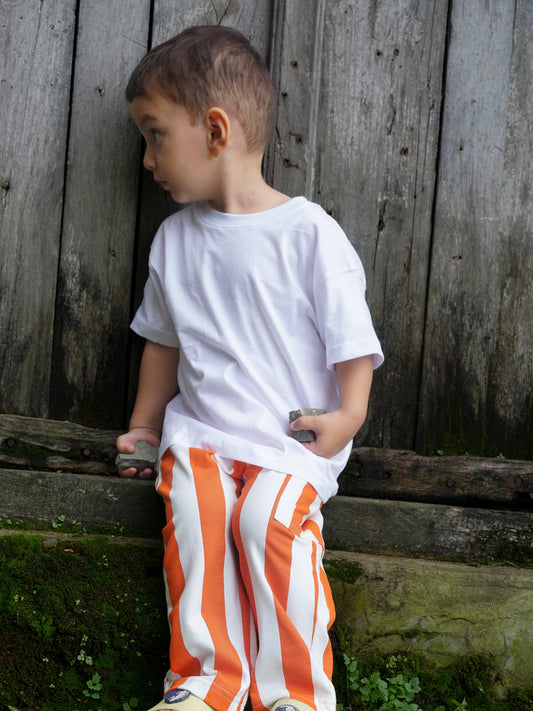
Printed cotton co-ord set
Friends Make Me Happy Co-ord Set for Kids
100% premium cotton, azo-free dyes, tagless labels and pre-shrunk fabric, with a loose, airy cut and stretchy neckline for easy dressing.
Does sizing change for T-shirts, pants, kurtas and night suits?
Yes. The age label stays the same but what you should check changes with the garment:
| Garment | Measurement to check first | Size advice |
|---|---|---|
| T-shirts and knit co-ord sets | Length, then chest | Knits stretch, so chest is forgiving. Make sure the hem still covers the waistband when the child lifts both arms. |
| Woven shirt sets (seersucker, poplin) | Chest | Woven cotton does not stretch. If the flat chest is less than about 1 inch wider than their best T-shirt, size up. |
| Shorts | Waist, then length | Elastic waists cover a range; length is a style choice (above or at the knee). |
| Full-length pants and joggers | Length | In our chart, pant length jumps most between 2-3Y and 3-4Y. Cuffed joggers can be bought slightly long because the cuff holds the hem off the floor. |
| Kurta pajama | Kurta length and chest | Kurta length is the look. Check that the pajama has an elastic or drawcord waist for long functions. |
| Night suits | Length of sleeves and legs | Choose the fit your child is comfortable sleeping in; avoid very long legs that trip them on the way to the bathroom at night. |
| Sweatshirts and winter sets | Chest and sleeve length | Room for a T-shirt underneath. Oversized styles are already cut large, so check their chart before sizing up again. |
For a deeper look at each garment, see our guides to choosing a T-shirt for a kid boy by fabric, fit and size, kurta fit and size by height for baby boys and how to choose sweatshirts for kids. You can also browse cotton night suits for kids and kurta pajama sets for kids in the same size labels.

Sizes 1 to 8 years
Tomato Tango Co-ord Set for Kids
A pure cotton T-shirt and shorts set for boys and girls; the wide size range means siblings can wear it together.
Why do some kids clothes fit smaller after a wash?
When a garment fits on day one and feels tight after the first wash, the cause is usually fabric, not the size chart. Cotton knit fabric is stretched during knitting and finishing, and if it is not stabilised before cutting, it relaxes and shrinks back in the first hot wash. That is why we pre-shrink the fabric for our printed co-ord sets before stitching, and why the label matters as much as the chart. Two other things affect fit after washing:
- Fabric weight. Very thin fabric loses shape faster. Our guide to what GSM in fabric means explains how to judge weight.
- How you wash and dry. Hot water and a hot tumble dryer tighten cotton. Wash cold and dry in shade; our cotton care guide has the full routine.

60 second size checklist before you order
- Measure height without shoes. Find the row in the age and height table.
- Check whether the brand chart shows body or garment measurements (a 1-2Y chest under 15 inches means flat garment).
- Lay a T-shirt that fits flat and compare chest and length with the chart.
- For woven shirts, make sure the chest has about an inch more room than the T-shirt.
- For pants, check the length; for shorts and elastic waists, check the waist.
- Under 3: buy for now. Over 4: size up only for winter, festive and night wear.
- Check that the fabric is pre-shrunk, and try it on before the first wash in case you need an exchange.
Every Gozi order comes with 7-day returns, with a free reverse pickup and one exchange per order, so if the size is not right you can swap it. Items must be unused, unsoiled and unwashed.

Printed cotton co-ord set
The Sip Squad Co-ord Set for Kids
100% premium cotton, OEKO-TEX Standard 100 certified, with a loose, airy cut for running, climbing and naps.
Frequently asked questions
What size is a 2 year old in kids clothes?
Most 2 year olds wear 2-3Y. The WHO median height is 87.1 cm for boys and 85.7 cm for girls at 2 years, the start of the 2-3Y band. If your child is still in nappies or is already taller than about 94 cm, consider 3-4Y for bottoms.
Is kids clothing size by age or by height?
Labels show age, but clothes are designed around height. Always check height first. A tall 4 year old often wears 5-6Y, and a petite 5 year old can still fit 4-5Y comfortably.
What does 2-3Y mean on a kids clothing label?
It means the garment is cut for a child between their second and third birthdays of average height, roughly 86 to 96 cm. It is a height band with an age name, not a rule.
How do I convert a kids size chart from inches to cm?
Multiply inches by 2.54. For example, a 12 inch flat chest is 30.5 cm, and a 14 inch length is 35.6 cm. To go from cm to inches, divide by 2.54.
Why is the chest on the size chart smaller than my child's chest?
Because most kidswear charts list the garment laid flat, which is half the circumference. Double the chart figure to get the full chest of the garment, then compare it with your child.
Should I buy kids clothes one size bigger?
Under 3, buy the size that fits, because children grow 9 to 11 cm a year at that age and a big size is soon too small anyway. From about 4, buying one size up for winter, festive and night wear is sensible.
Do Gozi clothes run small or large?
Our co-ord sets are cut in a relaxed fit and sized by age. Use the garment charts above and compare them with a piece that already fits. Our oversized sweatshirt sets are cut larger on purpose, so check their own chart rather than sizing up.
Found their size? Pick the outfit
Every Gozi co-ord set is made in pure cotton in our own Tiruppur unit, in sizes from 1 to 8 years.
Shop cotton co-ord sets for kids →100% cotton · 7-day returns · Free shipping · COD on orders under ₹5,000
Sources: WHO Child Growth Standards, length/height-for-age; WHO Growth Reference 5 to 19 years, height-for-age; Kuriyan R et al. Waist circumference and waist for height percentiles in urban South Indian children aged 3 to 16 years. Indian Pediatrics 2011;48:765-771; Khadilkar V et al. Revised IAP growth charts for height, weight and BMI for 5 to 18 year old Indian children. Indian Pediatrics 2015;52:47-55. Garment measurements: Gozi size charts as published on our product pages.
Tags: