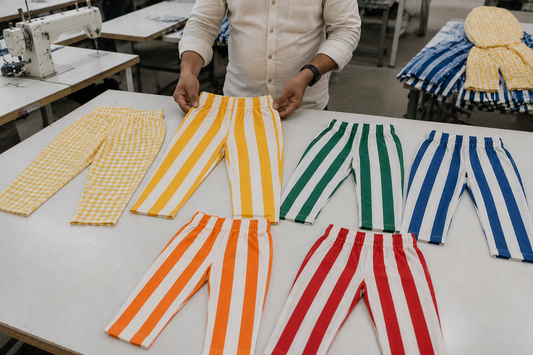

How Cotton Pants Help Prevent Heat Rash in Toddlers During Indian Summers
Heat Rash in Indian Toddlers: More Common Than It Should Be
Prickly heat — known medically as miliaria — is one of the most common skin conditions affecting Indian toddlers and young children during summer months. Walk into any paediatric clinic in North India between April and July and you will find a significant proportion of the appointments are for heat rash concerns. The characteristic red, pimple-like eruptions appear most commonly on the back, abdomen, inner thighs, and neck — all areas where clothing sits close to the skin.
Most parents are told by doctors to use cooling powders, lighter clothing, and more air conditioning. What is less commonly discussed is the direct relationship between specific clothing choices and heat rash occurrence. As cotton manufacturers who make kids' clothing specifically for Indian conditions, we want to address this directly.
How Heat Rash Develops
Miliaria occurs when sweat glands or sweat ducts become blocked. Sweat cannot escape normally through the skin surface and instead accumulates under the skin, causing inflammation and the characteristic rash.
The blockage is triggered by conditions that prevent sweat from evaporating: high ambient temperature, high humidity, and — critically — clothing that traps moisture against the skin. This last factor is where parents have the most direct control.
Fabric that absorbs and holds moisture against the skin creates exactly the conditions that lead to sweat duct blockage. Fabric that allows moisture to evaporate quickly, or that pulls moisture away from the skin surface, prevents the sustained moisture accumulation that triggers the condition.
Why Synthetic Fabric Increases Heat Rash Risk
Polyester and polyester-blend fabrics do not absorb moisture. When a toddler sweats in synthetic clothing, the sweat has nowhere to go except to stay at the skin surface. The fabric does not absorb it. The tight construction of most synthetic kids' pants means airflow is minimal. The result is a sustained layer of moisture against the skin — exactly the condition that triggers heat rash.
This is particularly problematic in the inner thigh area, where the thighs create friction against each other and the pants create a sealed environment against the skin. Inner thigh heat rash in toddlers who wear synthetic or synthetic-blend pants is extremely common. In our experience speaking with parents, switching to pure cotton pants with a relaxed fit resolves inner thigh heat rash in the majority of cases without any other intervention.
How Cotton Pants Reduce Heat Rash Risk
Cotton reduces heat rash risk through three mechanisms.
Moisture absorption: Cotton absorbs sweat from the skin surface. This reduces the sustained moisture contact that triggers sweat duct blockage. The moisture is held in the fabric structure, away from the skin, where it can eventually evaporate.
Breathability: The natural, open structure of cotton fabric allows air to circulate. This airflow carries moisture away through evaporation more effectively than synthetic fabric, reducing the temperature and humidity at the skin surface.
Non-irritating surface: Good quality combed cotton has a smooth, non-abrasive surface. In contrast to synthetic fabrics, which can create friction irritation that exacerbates existing heat rash, smooth cotton allows the skin to breathe and heal without additional mechanical irritation.
The Fit Factor in Heat Rash Prevention
Fabric choice alone is not sufficient if the fit is wrong. A pure cotton pant that is tight through the thigh creates similar conditions to a synthetic pant in terms of moisture trapping and airflow restriction in the high-friction inner thigh area.
Relaxed fit is an important secondary factor. A pant with adequate room through the thigh creates space for air circulation, reduces friction between fabric and skin, and prevents the sealed moisture environment that leads to heat rash. Our cotton pants are specifically cut with this in mind — a wide seat, relaxed thigh, and no constriction around the natural lines of movement.
Managing Existing Heat Rash with Clothing Choices
If your toddler already has heat rash, clothing management is part of the recovery process. Pure cotton pants in a loose, relaxed fit allow existing heat rash to heal by providing the cool, dry, low-friction skin environment that the rash needs to resolve.
Avoid tight waistbands that prevent airflow at the abdomen. Avoid any synthetic fabric in the pants or the underwear layer beneath. Wash pants in fragrance-free detergent to eliminate the potential irritation of fragrance compounds on already-reactive skin.
Find relaxed fit pure cotton pants designed for Indian summer conditions in our cotton pants collection.
Frequently Asked Questions
My toddler gets heat rash every summer. Can changing pants fabric make a difference?
Yes, in many cases significantly. The combination of switching from synthetic or synthetic-blend pants to pure cotton relaxed-fit pants is one of the most direct interventions available to parents. Many parents report dramatic improvement after this change alone.
Are there specific cotton pants styles that are better for heat rash prone children?
Loose, relaxed fit styles with wide waistbands are best. Among our range, the French Terry pants and check pants in relaxed fit are both suitable. The undyed inner layer of the French Terry pants also eliminates dye-related irritation, which can compound heat rash symptoms in sensitive children.
Does air conditioning prevent heat rash?
Reducing ambient temperature helps, but children in AC environments still sweat during active play. The fabric choice matters regardless of the ambient temperature, though it becomes less critical in very cool, controlled environments.
Is talcum powder helpful for heat rash in cotton-pant-wearing toddlers?
Cooling powder provides temporary symptom relief but does not address the root cause. Switching to appropriate clothing is a more effective long-term intervention than powder use alone.
Tags:
Previous
Biowashing: What It Is and Why It Matters for Your Child's Cotton Pants
Next
Baby Blue Check vs Melon Gingham: Which Cotton Pant Is Right for Your Toddler?