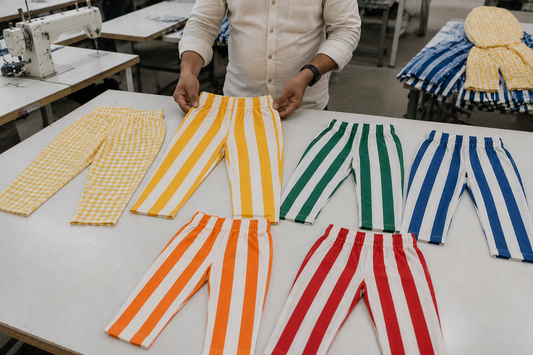

Gingham Pants for Kids: Why This Pattern Is Perfect for Indian Summers
Why Gingham Has Lasted 400 Years in Fashion
Gingham is one of the oldest fabric patterns in continuous production. It originated in Southeast Asia, arrived in Europe through trade, and has never left. There is a reason for that. Gingham — the simple check pattern formed by crossing two colours in equal-width stripes — is balanced, versatile, and visually satisfying in a way that trends cannot replicate. It works on a baby, a toddler, a teenager, and an adult. It works in summer and in winter. It works in India, France, the United States, and Japan.
For Indian kids' pants specifically, gingham has a set of practical advantages that make it more than just a pattern choice. This post explains what those advantages are and why we have built gingham into the core of our cotton pants range at Gozi.
What Makes Gingham Different From Other Check Patterns
There is a family of check patterns that often gets used interchangeably in conversation: gingham, plaid, tartan, windowpane, houndstooth. They are not the same thing.
Gingham specifically refers to a two-colour check where the same colour appears in both warp and weft threads, creating a pattern of evenly-sized solid squares and mixed-colour squares. The key feature is the visual simplicity. There are no more than two colours in true gingham, and the pattern is perfectly symmetric.
This simplicity is why gingham works so well on small children. Complex patterns — plaids, tartans, multi-colour prints — can visually overwhelm a small frame. Gingham scales beautifully. A toddler in a gingham pant looks put-together without looking overdressed.
Why Gingham Is Perfect for Indian Summer Conditions
Beyond aesthetics, gingham cotton has a structural advantage in Indian summer conditions. The woven check construction — as opposed to printed patterns — means the colour is built into the fabric structure itself. There is no surface print that can crack, fade unevenly, or add a chemical layer to the fabric.
In a summer where your child is sweating, being washed repeatedly, playing outdoors and in, a woven pattern is simply more durable than a printed one. Our gingham cotton pants use woven construction throughout. The check you see on day one is the check you will see after a hundred washes.
Gingham also tends to be woven in lighter cotton weights, which suits warm weather well. The even weave structure allows airflow, keeps the fabric from clinging to damp skin, and dries quickly after washing — a practical advantage in Indian households where laundry cycles are frequent.
The Gingham Styles in Our Cotton Pants Range
We currently carry several gingham styles in our cotton pants collection, each suited to different colour preferences and occasions.
Baby Blue Check: This is our bestselling gingham style and the one we receive the most repeat orders on. The blue-and-white check is classic without being boring. It pairs with virtually any solid colour top — white, navy, yellow, coral, lavender. It works for boys and girls equally. We have extended this style down to 6–12 months based on demand.
Melon Gingham: A coral-red and white check. Warmer and more energetic than the blue, this is popular for summer outings and slightly more festive occasions. The red family colours photograph beautifully in natural light, which is why this style is a favourite among parents who document their children's outfits.
Mint Gingham: A softer green-and-white combination. Suited to both genders and particularly popular in the spring-summer season when green palettes align with the natural environment.
Olive Gingham: A muted, earthy check for parents who prefer understated, neutral aesthetics. Pairs beautifully with our dark olive t-shirts and with white or cream tops.
How to Style Gingham Pants for Indian Kids
The fundamental rule of styling gingham is simple: keep everything else solid. Gingham is itself a pattern, so pairing it with another pattern creates visual clutter. A gingham pant with a solid-colour t-shirt is a complete, balanced outfit. The pant provides the visual interest; the top provides the colour harmony.
For Indian festivals and family occasions, gingham pants styled with a kurta or a cotton printed shirt can look unexpectedly smart. The Western pattern of the pant against a traditional Indian top creates an interesting contrast that works particularly well for children.
For everyday school or playdate wear, a simple white or off-white cotton t-shirt with a gingham pant is one of the most reliable combinations you can build a toddler's wardrobe around.
Browse all our gingham styles in the cotton pants collection.
Frequently Asked Questions
Is gingham suitable for boys and girls equally?
Yes. Gingham is one of the few patterns that is genuinely gender-neutral. Colour selection matters more than the pattern itself — a blue gingham reads neutral to most, while a red or pink gingham may feel more traditionally feminine, though many families choose both regardless.
Does gingham fade faster than solid-colour cotton pants?
Woven gingham uses yarn-dyed threads, where the colour is fixed at the yarn stage rather than printed on the surface. This typically gives better colour fastness than surface prints. Washing inside out in cold water preserves the check definition.
What tops pair best with gingham pants for toddlers?
Solid colours. White, navy, coral, yellow, and lavender are all reliable choices. The gingham provides the pattern interest; the top provides the colour anchor.
Are gingham pants appropriate for Indian summer heat?
Yes. Woven cotton gingham is lightweight, breathable, and quick-drying — all practical advantages in Indian summer conditions.
Tags:
Previous
How to Choose the Right Size Cotton Pants for Indian Toddlers (1–6 Years)
Next
How to Wash Cotton Kids' Pants in India: Hard Water, Colours, and Machine Wash Tips