
Why Indian-Made Cotton Pants for Kids Fit Better Than Imported Alternatives
The Export Surplus Problem Nobody Talks About Openly
India is one of the world's largest exporters of children's cotton clothing. Garments made in Tirupur, Surat, Ahmedabad, and dozens of other manufacturing centres flow to buyers in the United States, Europe, the UK, and Australia every year. Much of this production is excellent — manufactured to international quality standards that are often stricter than what Indian domestic brands demand.
The problem emerges in a specific category: export surplus, cancelled orders, and factory seconds. These are garments originally made for export markets that, for various reasons — order cancellations, slight quality variations, style changes by the foreign buyer — end up back in the Indian domestic market. They are sold at sharp discounts through wholesale markets, budget online platforms, and some physical retail channels.
Parents who encounter these garments often find clothes that feel excellent quality at a low price. The fabric may genuinely be good. But the design, sizing, and construction are optimised for a Western child's body in a Western climate — not for an Indian child's body in an Indian climate. This distinction matters more than most parents realise.
How Western and Indian Children's Bodies Differ
Children's bodies are not identical across geographies. Indian children aged 1 to 6 years, on average, have slightly different proportions compared to the European or American children for whom most export-standard sizing is calibrated.
Indian toddlers tend to have proportionally fuller abdomens relative to their overall frame — a natural characteristic of this age group that is more pronounced in Indian children whose diets include more home-cooked traditional food. Export-standard pants, cut for slimmer Western waistlines, can feel tight around the abdomen even when the height and age sizing seems correct.
Indian children also tend to have slightly shorter inseam lengths relative to their overall height. Export-standard pants calibrated for the average Western child of the same age can run long in the leg, creating the bunching-around-the-ankle problem that parents in India frequently report with imported or export-surplus kids' pants.
How Indian and Western Climates Require Different Fabric Choices
Export garments are typically designed for the destination market's climate. A cotton pant designed for a European retail buyer is likely constructed for a climate where 25 degrees Celsius is a warm summer day and air conditioning is rarely needed. The fabric weight, weave construction, and wash finish are calibrated for these conditions.
Indian summer conditions are radically different. Peak temperatures in North India regularly exceed 40 degrees Celsius. Humidity ranges from arid dry heat in Rajasthan to near-tropical moisture in coastal cities. The fabric specifications appropriate for a Paris summer are not the same as those appropriate for a Chandigarh summer. When export-standard garments reach Indian children, the thermal performance is often a mismatch with actual conditions.
What Indian-Made, Indian-Market-Optimised Cotton Pants Look Like
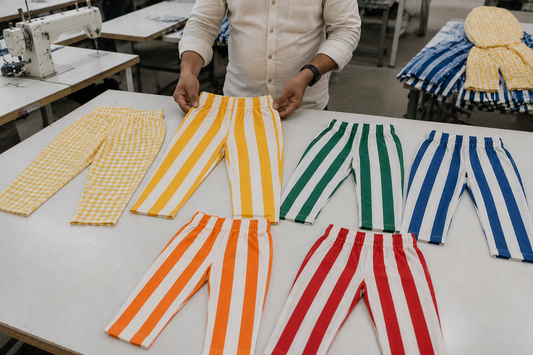
When we designed our cotton pants range, every specification decision was made with the Indian child and the Indian climate in mind.
The waist construction accounts for the fuller abdomen typical of Indian toddlers, with a generously sized waistband and enough ease in the seat to be comfortable without looking oversized. The leg length is calibrated against actual Indian children in the 1 to 6 year age range, not against Western sizing tables.
The fabric weight and weave are chosen for Indian summer conditions: lightweight enough to be comfortable in 38 degree heat, breathable enough to prevent heat rash, and coloured with dye formulations that hold up under the intense sun exposure and frequent washing that Indian conditions demand.
This is not a criticism of imported clothing. It is simply an observation that clothing designed for a specific market performs best in that market. For Indian children, Indian-made cotton pants with Indian market specifications are the right product.
Browse our range of cotton pants designed specifically for Indian children at Gozi Cotton Pants.
Frequently Asked Questions
Are international kids' clothing brands like H&M or Zara better than Indian brands for cotton pants?
For fabric quality in their upper-price garments, yes, international brands often maintain consistent standards. But their sizing and fabric weight are designed for European conditions. Indian-made pants in equivalent specifications often fit Indian children better and suit Indian climate conditions more appropriately.
How can I tell if a discounted kids' pant is export surplus?
Look for foreign brand labels that have been cut out or replaced, unusual sizing labels (in inches rather than centimetres, or in age ranges that do not match Indian conventions), and fabric weights that feel slightly heavy or stiff for the Indian summer context.
Is Indian cotton quality as good as Egyptian or American cotton?
India produces some of the world's finest cotton, including Suvin Gold, which is among the most prized long-staple cottons globally. Indian cotton quality at the top end is comparable to Egyptian or Pima cotton. The Indian market's challenge is not a lack of quality cotton but the variance across different production tiers.
Do Indian kids' clothing brands meet international safety standards for dyes?
The better Indian brands either hold international certifications (OEKO-TEX, GOTS) or apply equivalent standards voluntarily. Budget-segment production is more variable. As with any market, buying from transparent brands with verifiable manufacturing claims is the safest approach.
Tags:
Previous
Baby Blue Check vs Melon Gingham: Which Cotton Pant Is Right for Your Toddler?
Next
How to Build a Minimal Cotton Wardrobe for Your Toddler in India