
First Foods for Indian Babies: A Month-by-Month Guide and Chart (6 to 12 Months)
The short answer: start your baby on solid foods at six completed months, while you keep breastfeeding. Good first foods for an Indian baby are simple, freshly cooked home foods: a thick, well mashed khichdi of rice and moong dal, ragi or suji porridge, mashed vegetables like pumpkin, carrot and sweet potato, and soft fruits like banana and chikoo. Begin with 2 to 3 tablespoons, two or three times a day, and build up to 3 or 4 meals plus 1 or 2 snacks by 9 to 11 months. Skip salt, sugar and honey before the first birthday. The month-by-month chart below puts it all on one page.
Starting solids is one of those milestones that sounds simple until you are standing in the kitchen with a tiny steel bowl and a dozen opinions from family, WhatsApp groups and the internet. This guide brings together what the Indian Academy of Pediatrics (IAP) Infant and Young Child Feeding Guidelines, the World Health Organization, UNICEF India, the NHS and the American Academy of Pediatrics (HealthyChildren.org) actually say, and translates it into foods you already cook at home.
It matters more than it seems. According to UNICEF India, citing the National Family Health Survey (NFHS-5, 2019 to 2021), only about 46 per cent of Indian infants aged 6 to 8 months receive complementary foods alongside breast milk, and only 1 in 10 children aged 6 to 23 months are fed in line with WHO's recommended practices. Most of us are not doing anything wrong on purpose. We just were never given a clear, simple plan.
When should my baby start solid foods?
The IAP guideline says complementary foods should be introduced at six completed months, while breastfeeding continues on demand. WHO gives the same advice: exclusive breastfeeding for the first six months, then safe and adequate complementary foods, with breastfeeding continuing up to two years or beyond. The IAP also suggests we drop the word "weaning", because starting food does not mean stopping breast milk.
Age is the main guide, but your baby will also show you they are ready. The NHS lists three signs that usually appear together around six months:
- They can stay in a sitting position and hold their head steady.
- They can coordinate eyes, hands and mouth to look at food, pick it up and put it in their mouth.
- They can swallow food rather than pushing it back out.
Reaching for your plate or chewing fists on their own is not a reliable sign. If your baby was born early or you are unsure, ask your paediatrician when to begin.
What are the best first foods for an Indian baby?
The best first foods are the ones your family already eats, cooked plainly and mashed to the right texture. You do not need packaged baby cereals. The IAP actually advises against ready-made, processed commercial foods and recommends a homemade cereal and pulse mix in a 2:1 ratio as the staple. In an Indian kitchen, that is simply two parts rice (or broken wheat, ragi, suji or another grain) to one part dal, cooked soft and mashed. Think plain moong dal khichdi.
From there, the IAP says to gradually add fruits, green and dark coloured vegetables, milk products, pulses, animal foods and a little oil or ghee. Some practical examples:
- Grains: rice, ragi, suji (rava), broken wheat (dalia), jowar, bajra. Our detailed guide on whether ragi is good for babies covers ragi on its own.
- Pulses: moong dal first (it is soft and cooks quickly), then masoor, toor and others.
- Vegetables: pumpkin, bottle gourd (lauki), carrot, sweet potato, potato, beans, spinach and other greens.
- Fruits: banana, chikoo, papaya, steamed apple or pear, mango in season.
- Dairy: plain homemade curd. Cow's milk can go into cooking, but not as the main drink (more on this below).
- Animal foods for non-vegetarian families: well cooked egg, fish and chicken, mashed or finely shredded. WHO advises giving young children meat, poultry, fish or eggs as often as possible, and UNICEF India suggests eggs, fish or chicken for families who eat them.
- Energy: a little ghee, butter or oil stirred into meals. The IAP specifically suggests ghee, butter or oil to make each meal energy dense, which matters because a baby's stomach is tiny.
A note on sugar and jaggery. The 2016 IAP guideline mentions sugar or jaggery as a way to add energy. Newer advice is stricter: the WHO's 2023 complementary feeding guideline says children should avoid foods and drinks high in sugar, and UNICEF India and the NHS say to avoid added sugar. Ghee or oil is the better way to add energy.
What about iron? HealthyChildren.org (AAP) advises including iron and zinc rich foods once solids begin. In Indian homes, that means pulses, ragi, green leafy vegetables, and egg, fish or meat if your family eats them.

Month-by-month baby food chart (6 to 12 months)
This chart puts the IAP and WHO guidance on texture, meal frequency and portion size side by side with everyday Indian foods. Meals and amounts come from the IAP guideline (Table I) and WHO. The food ideas are examples, not rules. Breastfeeding continues on demand throughout.
| Age | Texture | Meals a day | How much per meal | Indian foods to try |
|---|---|---|---|---|
| 6 months (first weeks) | Thick porridge and well mashed food, thick enough to stay on a tilted spoon | 2 to 3 (begin with small tastes) | Start with 2 to 3 tablespoons, increase slowly | Moong dal and rice khichdi, ragi or suji porridge, mashed pumpkin, carrot, sweet potato, mashed banana or chikoo |
| 7 to 8 months | Mashed, slightly lumpier; soft finger foods from about 8 months | 2 to 3 | Gradually more, moving towards half a 250 ml bowl | Dalia, mashed idli, vegetable khichdi with ghee, plain curd, mashed egg or fish (if non-vegetarian), steamed carrot or apple sticks as finger food |
| 9 to 11 months | Finely chopped or mashed food, plus foods baby can pick up | 3 to 4, plus 1 to 2 snacks depending on appetite | About half a 250 ml bowl | Soft rice with dal and vegetables, soft chapati pieces dipped in dal, upma, poha, paneer, soft fruit pieces, shredded chicken (if non-vegetarian) |
| 12 months | Family foods, chopped or mashed if needed | 3 to 4, plus 1 to 2 snacks | Three quarters to one full 250 ml bowl | What the family eats, made with less salt and spice before serving: rice, roti, dal, sabzi, curd, fruit |
Sources: IAP Infant and Young Child Feeding Guidelines 2016 (texture, frequency, amounts); WHO (texture by age and meal frequency). If your baby is not breastfed, the IAP table adds 1 to 2 cups of milk and 1 to 2 extra meals a day; ask your paediatrician what suits your baby.
How do I introduce new foods, including common allergens?
Go slowly and keep it simple. The NHS suggests offering a few teaspoons of food before your baby's usual milk feed in the early days, and not worrying about how much they eat. The goal at first is getting used to new tastes and textures.
- One new food at a time. HealthyChildren.org suggests introducing single-ingredient foods one at a time, every 3 to 5 days, so you can spot a reaction.
- Do not delay common allergens. The NHS says foods like hen's eggs, peanuts (ground or as smooth paste, never whole), gluten and fish can be introduced from around six months, one at a time and in small amounts. The AAP notes there is no evidence that waiting beyond 4 to 6 months to introduce soft allergy-causing foods prevents food allergy.
- Talk to your doctor first if there is a family history of allergies (NHS), or your baby has severe eczema or a known egg allergy, in which case the AAP recommends asking about peanut allergy testing before introducing peanut.
- Offer refused foods again. The IAP notes that wariness of new foods is normal in children, so a food may need to be offered several times before it is accepted.
Which foods should babies not have before their first birthday?
| Food or practice | What the guidance says | Source |
|---|---|---|
| Honey | Not until after 1 year, because it can contain bacteria that cause infant botulism | NHS |
| Salt | Do not add salt to baby's food or cooking water; avoid stock cubes. Take baby's portion out before salting the family pot | NHS, UNICEF India |
| Sugar and sweets | Babies do not need sugar; avoid sweetened foods and drinks | NHS, UNICEF India, WHO 2023 |
| Fruit juice | No juice under 12 months; offer whole fruit instead | AAP |
| Packaged snacks | Avoid chips, biscuits, namkeen, sweets and packaged juices | UNICEF India, IAP |
| Whole nuts | Not for children under 5 because of choking; ground nuts or smooth nut paste in food are fine | NHS |
| Small round foods | Cut grapes and cherry tomatoes into quarters | NHS |
| Cow's milk as the main drink | Fine in cooking from around 6 months, but not as the main drink until 1 year | NHS |
| Bottle feeding of foods | Discouraged; use a bowl, spoon and open cup | IAP |
From around six months, the NHS also suggests offering sips of water from an open or free-flow cup with meals.
How should I feed my baby? Responsive feeding explained
How you feed is as important as what you feed. Both WHO and the IAP recommend responsive feeding, which means watching for your baby's hunger and fullness cues and responding to them.
- Feed slowly and patiently, and encourage, but never force. The IAP says forced feeding, threats and punishment interfere with good eating habits.
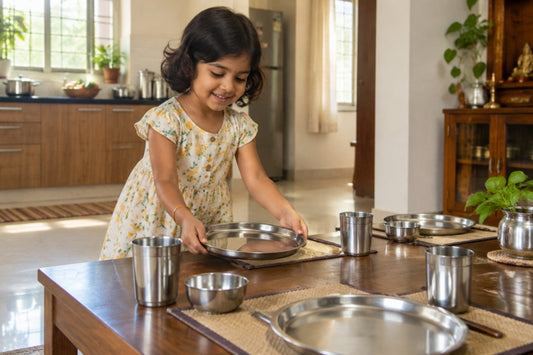
- Give your baby their own plate or bowl, so you can see how much they actually eat (IAP, UNICEF India).
- Let them touch, squish and try to feed themselves, even if it is messy. The IAP encourages self-feeding despite spills.
- Talk, smile and make eye contact. WHO describes feeding times as "periods of learning and love".
- If your baby refuses a food, WHO suggests experimenting with different combinations rather than pushing.
- Always stay with your baby while they eat. The NHS explains that gagging (watery eyes, tongue pushing forward, retching) is a normal part of learning, but you should never leave a baby alone with food.

How do I keep my baby's food safe and clean?
The IAP calls hygiene "essential" at every step: preparation, storage and feeding. In practice:
- Wash your hands with soap and water before preparing food and feeding, and after using the toilet (IAP).
- Use a separate bowl for your baby and wash utensils thoroughly (UNICEF India).
- Cook eggs until both the white and the yolk are solid (NHS), and cook fish and meat well before mashing.
- Prefer freshly cooked home food over packaged foods (IAP).
Your first foods checklist
Save or screenshot this list for the first few weeks:
- ☐ Baby has completed 6 months and shows the readiness signs
- ☐ Breastfeeding continues on demand
- ☐ First meals are thick enough to stay on a tilted spoon
- ☐ Start with 2 to 3 tablespoons, 2 to 3 times a day
- ☐ One new food at a time; allergens introduced one by one from around 6 months
- ☐ A little ghee or oil in meals for energy
- ☐ No salt, sugar, honey, juice or packaged snacks
- ☐ Finger foods from about 8 months; family foods by 12 months
- ☐ Separate bowl, clean hands, freshly cooked food
- ☐ Always sit with baby while they eat
- ☐ Regular growth checks with your paediatrician or Anganwadi worker
When should I see a doctor?
Most babies take to solids gradually, with plenty of messy days and some refusals. But some signs need medical attention.
Get emergency help immediately if, after eating, your baby has (from the NHS food allergy guidance):
- sudden swelling of the lips, mouth, tongue or throat
- difficulty breathing, very fast breathing or noisy breathing
- skin, tongue or lips turning blue, grey or pale
- becoming limp, floppy or not responding as they normally do
See your paediatrician soon if:
- you notice possible allergy signs such as an itchy raised rash, swelling around the face or eyes, vomiting or diarrhoea after a new food (NHS)
- your baby stops breastfeeding or bottle feeding while unwell, or shows signs of dehydration such as fewer wet nappies (NHS)
- they keep vomiting and cannot keep fluids down, or there is blood in their poo (NHS). Green vomit needs emergency care
- there is a family history of allergy, or your baby has severe eczema or an egg allergy, before you introduce common allergens (NHS, AAP)
- you are worried about weight gain or growth. UNICEF India recommends regular growth checks so that faltering growth is caught early
Frequently asked questions
What is the best first food for an Indian baby?
There is no single best food. A thick, well mashed khichdi made from two parts rice and one part moong dal follows the IAP's recommended 2:1 cereal and pulse mix and is an easy start. Ragi or suji porridge, mashed vegetables and mashed banana are also good early choices.
Can I give dal water or rice water as my baby's first food?
The IAP recommends that first foods be thick enough to stay on the spoon when it is tilted, and says that thin, low-energy foods should be made denser. Dal water and rice water are thin and low in energy, so mashed dal and rice is the better choice.
Can I give ghee to my 6 month old baby?
Yes, in small amounts. The IAP recommends adding ghee, butter or oil to make each meal energy dense. A small amount stirred into khichdi or porridge is an easy way to do this.
How many times a day should a 7 month old baby eat solids?
WHO and the IAP recommend 2 to 3 meals a day between 6 and 8 months, alongside frequent breastfeeding. This rises to 3 to 4 meals, plus 1 to 2 snacks if your baby is hungry, from 9 months.
When can my baby eat the same food as the family?
WHO says most children can eat the same types of food as the rest of the family from 12 months, chopped or mashed if needed. Take your child's portion out before adding salt, and keep spice mild.
Can I give cow's milk to my 6 month old?
The NHS says cow's milk can be used in cooking or mixed into food from around six months, but should not be given as the main drink until your baby is one year old.
This article is for general information and is not a substitute for advice from your child's doctor.
Related reading
- Is Ragi Good for Babies? Everything Indian Parents Need to Know
- How to Increase Immunity in Child Naturally in India
Every baby moves through these stages at their own pace, so use the chart as a guide, not a test. For more practical, well-sourced guides on raising little ones in India, explore the rest of our Notebook.
Sources
- Tiwari S, et al., for the IYCF Chapter of the Indian Academy of Pediatrics. Infant and Young Child Feeding Guidelines, 2016. Indian Pediatrics 2016;53:703 to 713.
- World Health Organization. Child health: recommended food for the very early years.
- World Health Organization. WHO Guideline for complementary feeding of infants and young children 6 to 23 months of age (2023).
- UNICEF India. Complementary feeding practices for parents and caregivers and Early childhood nutrition.
- NHS. Your baby's first solid foods and Foods to avoid giving babies and young children.
- American Academy of Pediatrics, HealthyChildren.org. Starting solid foods.
Tags:
Previous
7 Kurta Pajama Ideas for Kids This Diwali: Pure Cotton Looks for Ages 1 to 8
Next
What Is GSM in Fabric? Full Form, Formula and the Right GSM for Kids' Clothes